Mining the built environment: HOW GREEN BUILDINGS CAN PRODUCE FERTILISERS
Urine recycling challenges the outdated flush-and-forget model, turning buildings into resource hubs. By capturing nutrients at source, we can create sustainable fertiliser, conserve water and strengthen resilience in the circular sanitation economy.
The traditional way we deal with toilets is a linear, flush-and-forget system. We take high-quality drinking water and use it to move our waste through kilometres of old pipes to large, centralised treatment plants. For the green building sector, this is no longer a smart or sustainable way to build. We need to rethink the building not just as a place that uses up resources, but as a factory that produces them. Central to this transformation is the way we perceive and manage the urine currently lost to our sewers. By shifting our focus to what we traditionally consider waste, we find that human urine contains most of the valuable nutrients we find in municipal wastewater, including about 80% of the nitrogen, 50% of the phosphorus and 70% of the potassium. Right now, we flush these nutrients away, which contributes to the disruption of natural cycles and the pollution of our water bodies.
Adversity drives innovation
The spark for my research at the University of Cape Town (UCT) was the drought in 2017. We needed a way to handle sanitation that did not need the water grid or the city sewer lines to operate. I conceptualised a fertiliser-producing urinal that could collect and treat urine on site without using a single drop of water. One of my students, Craig Flanagan, built and tested the first version, which won first prize in the 2017 engineering stream of the Greenovate competition.
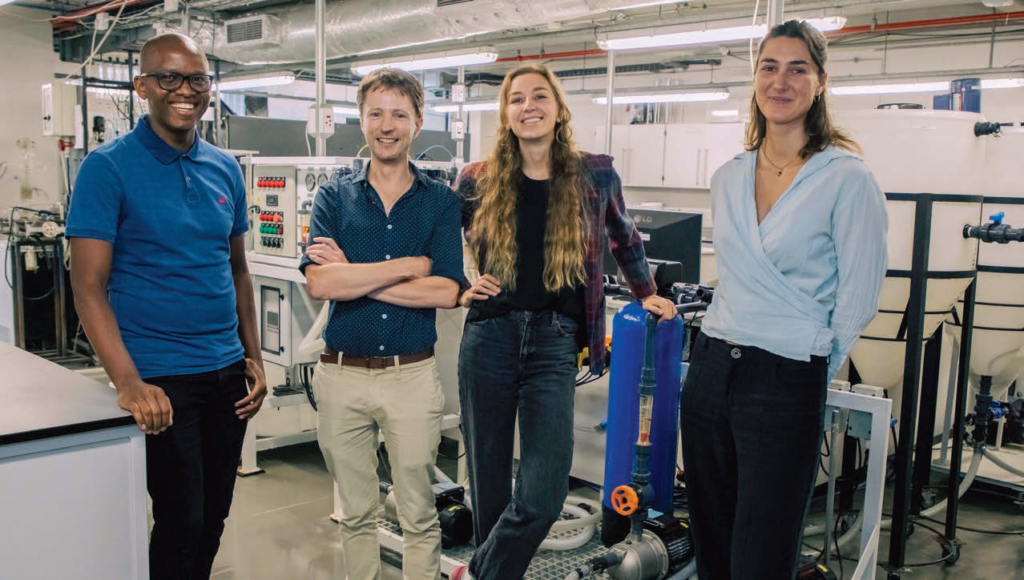
These urinals have been working in the New Engineering Building at UCT ever since. They serve as a real-world laboratory where we turn human urine into fertiliser. We have grown this project from a small lab experiment (7 litres) to a plant that can treat 3 200 litres of urine per day, although we usually run it at a smaller scale (approximately 130 litres) while we work on collecting more urine.
Circular sanitation
To understand why this is a big deal for a building owner, think about what is inside a toilet. Urine is about 100 times more concentrated than normal wastewater. In a standard building, we take this concentrated liquid and water it down with large amounts of flush water, only to spend money trying to treat it later at wastewater treatment plants. Our approach is different and is called source separation, which just means keeping the urine separate from everything else from the very start.
This makes it much easier and cheaper to treat. The field has grown tremendously over the past decade or so and there are now innovative toilets, such as the Laufen Save! toilet, that allow for the easy separation of urine and faeces within the toilet bowl itself. The only additional requirement for a developer to enable this is the installation of a dual piping system. This is why it is critical to install such systems in new builds; trying to retrofit a separate pipe network into an existing building later is incredibly expensive. By designing for source separation today, developers can future-proof their buildings for the circular sanitation economy.
A significant problem with urine is that if left, it starts to smell and loses its best nutrient (nitrogen) to the air as ammonia gas. This happens because the liquid naturally changes its chemistry over time. To stop this, we use a process called stabilisation. By adding a small amount of a common material like calcium hydroxide (lime) or an acid to the fresh urine, we freeze the chemistry in place. This stops the bad smells from forming and keeps the nitrogen locked in the liquid so it can be later used as fertiliser. By doing this right inside the building, we turn a smelly problem into a stable, valuable resource.
Commercial application
For developers and managers, the bottom line is whether this works in a commercial setting. These systems are not just laboratory concepts; they have already been successfully installed and operated in various locations across Switzerland, Sweden, Australia and the USA. Closer to home, the Exxaro building in South Africa has also implemented a urine-collection system.
Another major potential for these systems is to collect urine from periodic spikes in volume, such as those produced during sporting events or music festivals at large stadiums. Last year, another student of mine, Aqeelah Sharief, looked at the numbers for the Cape Town Stadium. Her research showed that it is economically possible to install a system there to produce fertiliser and recycle the water used to flush urinals. Her work won her first prize at the 2025 Greenovate competition in the Engineering category.
From flushing to fertile fields
Another challenge is that urine is mostly water, about 95% of its weight. To make it easy to move and sell, we must remove this water. We can use different methods to do this and leave the nutrients behind. To achieve this, our process focuses on using reverse osmosis, which is the same technology used to desalinate seawater. By applying this method to stabilised urine, we can recover up to 90% of the valuable nutrients in a much more manageable, concentrated form. Our approach also uses 10 to 15 times less energy (10kW/m3) than other water-removal methods such as evaporation or distillation.
The recycled fertiliser products represent a legitimate shift in agricultural technology. Trials consistently show that urine-based fertilisers are highly effective, providing a nutrient supply that matches the performance of expensive synthetic fertilisers that farmers rely on today. This is not just about being environmentally conscious; it is about providing a high-performance, locally sourced alternative to volatile global fertiliser markets.
The environmental impact of this shift is significant. Currently, the world relies on industrial processes to create synthetic nitrogen fertilisers, a method that consumes a large amount of the world’s energy. Meanwhile, the phosphorus we use is mined out of the ground and is slowly running out. If we recycled the nutrients from everyone’s urine, we could cover nearly 20% of the world’s need for nitrogen and 11% of the need for phosphorus. In a country that should care about its limited water resources, we need to stop seeing wastewater as a nuisance and start seeing it as a valuable resource.
Waste as a resource
The biggest hurdle is often just getting people past the yuck factor. We do this by changing the way we talk about “waste”. When we stop using the word “waste” and start calling it a “resource”, the whole conversation changes. Essentially, we are just copying nature, where nothing is ever wasted and everything is recycled. Think of a forest where a fallen tree becomes the soil for the next generation of plants. We are just bringing that same logic into our buildings.
These systems are about building the independence and resource security our country needs. Imagine a future where large office blocks or stadiums are designed as resource hubs. Urine is collected from special toilets that keep liquids and solids separate. The liquid is then piped to a small treatment unit in the building that filters out any traces of medicines or germs, making the final fertiliser safe to use on gardens or farms. By following such an approach, we create a resilient, circular sanitation economy where nature’s logic is applied to the built environment: nothing is wasted, and everything is reused.
www.peecycling.co.za

Dr Dyllon Randall is a professor in Water Quality Engineering at the University of Cape Town (UCT). A chemical engineer by training, with a PhD in the field, he specialises in resource recovery from waste-waters, specifically focusing on converting human urine into sustainable fertilisers and innovative building materials. His work, which sits within the Future Water Institute, gained international recognition for the development of the world’s first bio-brick grown from human urine and the development of innovative urine recycling processes. Beyond his academic research, he is a co-founder and director of Pee-cycling, a UCT startup dedicated to commercialising urine-to-fertiliser technologies. A qualified Professional Engineer (Pr Eng), he has been shortlisted for the Royal Academy of Engineering Africa Prize (see https://africaprize.raeng.org.uk/2026-cohort/dyllon-randall/) and continues to lead research aimed at creating a resilient, water-sensitive future for South African cities.