Water efficiency in EDGE estates: REAL-WORLD impact
In EDGE‑certified residential estates, water efficiency delivers more than utility savings – structured financial mechanisms demonstrate returns, ease debt burdens, enable reinvestment and strengthen resilience in South Africa’s housing market.
For many South African households, water has become an increasingly significant aspect of monthly living costs, influenced by usage restrictions and rising municipal tariffs. While green building initiatives have historically focused on energy efficiency, water efficiency has emerged as a critical component of sustainable residential development, particularly in water-stressed regions such as the Western Cape.
Water efficiency is a key component of all Green Building Council South Africa (GBCSA)’s green building certifications, including the IFC EDGE (Excellence in Design for Greater Efficiencies) tool. As EDGE-certified residential developments continue to expand, questions remain regarding the extent to which water efficiency delivers measurable financial benefits for households and residential investors. This question is particularly relevant in the South African context, where household savings rates remain low and a significant proportion of residents are vulnerable to financial instability.
Water, redefined
South Africa faces persistent water security challenges, driven by climatic variability, infrastructure constraints and rising municipal tariffs, with these pressures most acutely felt in water-scarce regions. In the residential property sector, water has become an increasingly material operating cost, with implications for household affordability. In response, developers have begun incorporating water-efficient design measures to reduce potable water consumption and mitigate future supply risks. Green building certification, such as that offered through GBCSA, is one way of structuring and verifying these savings. For example, the IFC EDGE tool requires buildings seeking certification to demonstrate 20% more water efficiency (i.e., they must use 20% less water) than a baseline building. Despite the growing uptake of EDGE certification, limited empirical evidence exists on the extent to which residential water efficiency translates into measurable financial savings for households and property owners.
Counting the cost of water
A study* examined the financial implications of water efficiency in EDGE-certified residential housing, focusing on how reductions in household water consumption can be translated into practical financial mechanisms for homeowners. A quantitative multiple case study approach was applied, using 12 months of verified water consumption data from five residential developments in Cape Town. The sample comprised 684 two-bedroom apartments across both EDGE-certified and non-EDGE housing stock.
Two developments were EDGE-certified, while three comparable developments established the non-EDGE benchmark. Units were matched by typology and size to ensure a consistent basis for comparison. The non-EDGE developments recorded an average monthly water consumption of 49.40kL per unit, compared with 39.13kL and 27.31kL for the EDGE-certified developments. This equates to monthly savings of 10.27kL and 22.09kL per unit, respectively.
Consumption differences were monetised using the City of Cape Town’s stepped residential tariff structure. To assess how these savings could be leveraged beyond immediate utility cost reductions, residential bond finance assumptions were applied, including an 80% loan-to-value ratio, a 20-year loan term, and an interest rate of 9.5%, calculated as the prevailing prime lending rate less 1% at the time of analysis. Monthly water-related savings were added to bond repayments to determine reductions in loan duration. Following bond settlement, the freed-up instalments were modelled across alternative financial pathways to evaluate their potential influence on longer-term household financial positioning.
Water leading to liquidity
EDGE-certified residential units recorded materially lower water consumption than comparable non-certified housing. Under the City of Cape Town’s stepped residential tariff structure, the water consumption reductions resulted in average monthly household savings of R980.00 and R1 779.13, equivalent to R11 760.04 and R21 349.60 per annum.
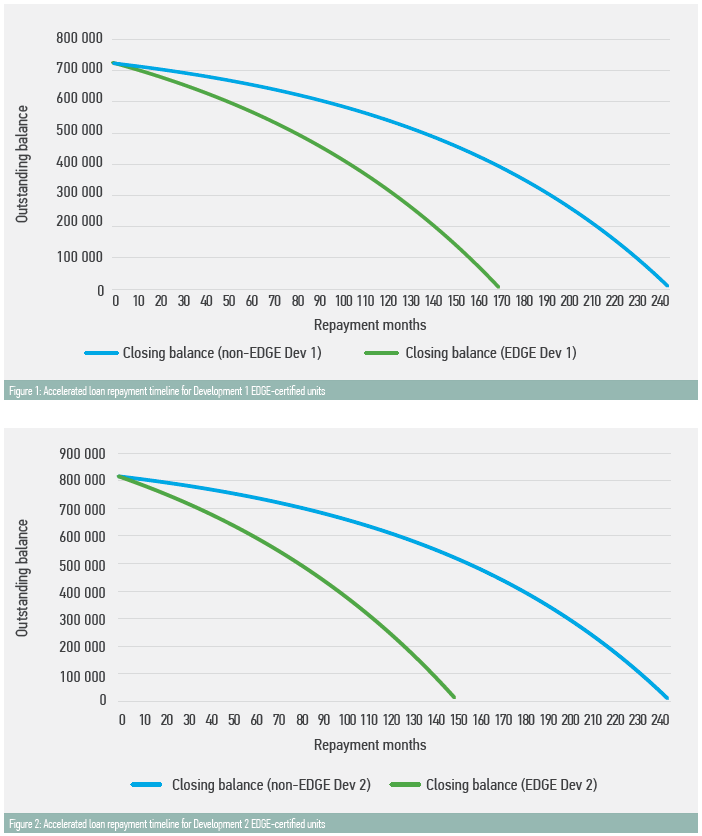
The study assessed how these savings would perform if reinvested into South African government bonds, which are widely regarded as a low-risk investment option. Government bond yields range from approximately 8.12% to 10.89% across 5-, 10-, 20- and 30-year terms. When annual water savings were invested at these yields, the resulting future values ranged from R17 375.56 to R460 501.06 When applied directly to residential bond repayments, these savings reduced the standard 20-year loan term by 69 and 93 months for Development 1 and Development 2, respectively, as illustrated in Figures 1 and 2. This translated into cumulative interest savings of R300 647.63 and R445 843.07, respectively.
Efficiency to equity
A hypothetical model was developed to assess how household water savings could be converted into longer-term financial value. The EDGE Savings Investment Model (ESIM) applies once water-related savings have accelerated bond repayment. Thereafter, the retained bond instalments are redirected into a balanced investment fund under the ESIM. Early bond settlement allows the monthly bond repayments of R7 765.92 and R9 385.32 to be invested for the remaining portions of the original 20-year (240-month) loan term, being 69 months and 93 months, respectively. The balanced investment fund is assumed to generate an annual return of 10.5%, reflecting a moderate estimate of prevailing market performance. Under this model, the future value of the ESIM equates to R731 476.55 per two-bedroom unit in Development 1 and R1 339 024.21 per two-bedroom unit in Development 2 over the respective remaining investment periods.
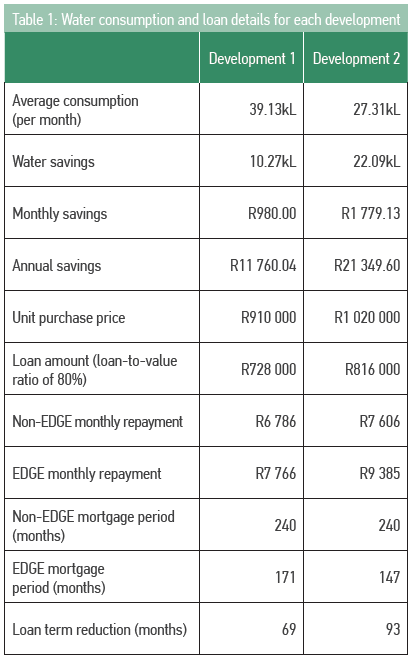
To enable comparison with household debt exposure, the present value (PV) of these returns is calculated using an annual inflation rate of 4.5%. The PV is then expressed as a proportion of the original loan amount to derive the Real-World Savings (RWS) Loan Ratio. The resulting RWS Loan Ratios of 41.66% for a two-bedroom unit in Development 1 and 68.04% for a comparable unit in Development 2 indicate that, in today’s monetary terms, the investment returns represent a substantial proportion of the original residential bond values (Table 1).
Water efficiency in residential buildings extends beyond reduced utility consumption and environmental benefit. When assessed through structured financial mechanisms, such as accelerated debt repayment and reinvestment, efficiency gains reveal their capacity to generate real-world savings and contribute to long-term household financial resilience. In the South African context, where affordability pressures and limited savings are prevalent, EDGE-certified residential developments demonstrate that sustainability interventions can operate not only as cost-containment measures, but as financially productive assets within the South African housing market.


Justine Braaf graduated with distinction in 2025, earning a Bachelor of Science (Honours) in Property Studies at the University of Cape Town (UCT). Throughout her undergraduate studies, she was consistently recognised on the Dean’s Merit List from first through fourth year and received numerous academic awards, including the Property Studies Third Year Prize, the Paragon Lending Solutions Prize and the Sanderson Weatherall Prize, as well as several departmental prizes and class medals. In 2025, Justine and Benjamin were awarded first prize in the Property Category at the Greenovate Awards and the IFC EDGE Award for their research on this topic.

Benjamin van Rhyn earned a B Sc (Honours) in Property Studies from the University of Cape Town (UCT), graduating with distinction. During his undergraduate and Honours studies, he was recognised for multiple first-place course results for academic excellence. In 2025, at the Greenovate Awards, Benjamin and Justine also received the IFC EDGE Award for their research on the subject of this article. Benjamin has since continued to build on this expertise and now works as an analyst at AESG in Cape Town, with a focus on sustainability in the built environment and contributing to large-scale international projects.
The authors gratefully acknowledge Dr Saul Nurick for his guidance, supervision and valuable insights throughout this research. His expertise and thoughtful feedback played an important role in shaping the development and quality of this study. Computations were performed using facilities provided by the University of Cape Town’s ICTS High Performance Computing team:
hpc.uct.ac.za – https://doi.org/10.5281/zenodo.10021612


