Designing for HUMANITY
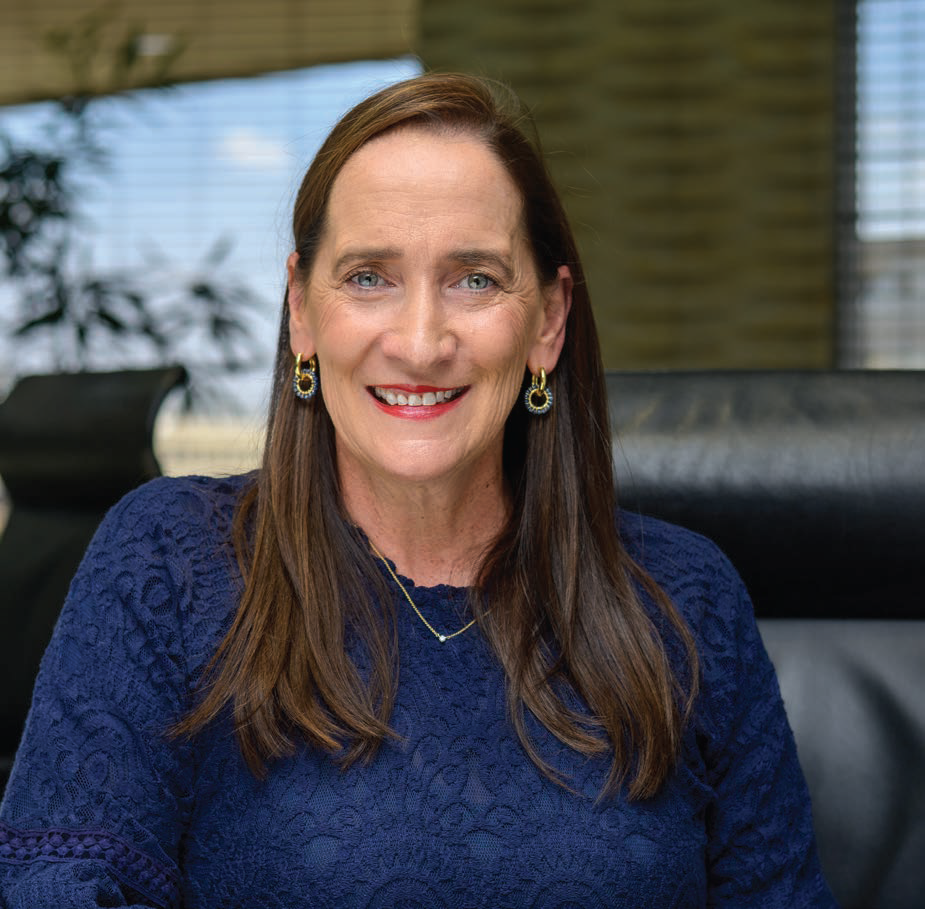
Amelia Beattie, Head of Business Efficiencies, Property and Sustainable Impact for Insurance and Asset Management at Standard Bank Group, explores why sustainable spaces should care for people first, championing human‑centred design as Africa’s green building foundation.
In cities that never slow down, the places in which we work often ask more of us than they give back. Noise, pressure, long hours, and disconnection have become accepted features of modern professional life. Yet, as conversations around sustainability evolve, a quieter but more profound question is emerging: What if our buildings were designed not only to perform, but to care?
By any conventional measure, sustainability is a story of performance metrics, energy-efficiency targets, water savings and green building certifications. These are the benchmarks that dominate industry conversations and shape investment decisions across the built environment.
For Amelia Beattie, Head of Business Efficiencies, Property and Sustainable Impact for Insurance and Asset Management, a business unit of the Standard Bank Group, sustainability has never been an abstract concept or a checklist of compliance. It is deeply human. It is about how a space makes people feel when they arrive, how it supports their mental and physical well-being throughout the day and how it contributes positively to the community beyond its walls.
IT begins with people
For Beattie, sustainability is not simply about creating buildings that perform better but also about developing places that help people flourish. “If people don’t feel better, healthier, safer or more connected in a space, then we’ve missed the point,” she says. It is this perspective that has helped position her as one of South Africa’s leading voices on the intersection between sustainability, business responsibility and human-centred development.
At a time when cities around the world are grappling with environmental pressures, growing inequality and widespread concerns around mental well-being, Beattie believes the property sector has an opportunity, and an obligation, to think differently about its role. “The buildings and precincts that define our cities are not neutral structures. They influence how people move, interact, work, rest and connect. They shape experiences and behaviours in ways that are often invisible but profoundly important,” she says. “Property developers and asset owners have tremendous influence over how cities evolve. With that influence comes responsibility. Every decision we make affects people, communities and the environment around us.”
Well-being through design
Throughout her career, Beattie has consistently challenged the notion that commercial success and social impact exist in opposition to one another. Instead, she argues that long-term value is created when environmental sustainability, social well-being and economic performance are viewed as interconnected outcomes.
This philosophy reflects a broader shift occurring within global sustainability leadership. Increasingly, organisations are recognising that environmental performance cannot be separated from human experience. Buildings that support well-being are more productive. Precincts that create a sense of belonging are more resilient. Developments that strengthen communities generate enduring value for both society and business.
She often describes sustainable buildings as preventative healthcare assets for cities. Access to daylight, fresh air, green spaces, walkability, safety and inclusive design all contribute to improved physical and mental health outcomes. “People spend a significant portion of their lives in and around buildings,” Beattie says. “The environments we create have a direct impact on health, productivity and quality of life.”
A human-centred approach
Few projects illustrate this philosophy more clearly than Liberty Indwe Park in Braamfontein. Situated directly opposite Wits University, it encompasses the precinct of Liberty’s own headquarters and a building that once housed South African Breweries. The design of the park incorporates Liberty’s human-centric approach to empowering employees, clients and its advisor partners and, by extension, the broader community of the precinct.
The project was developed internally by Liberty Two Degrees, a subsidiary of Liberty that manages a portfolio of premium retail, office, residential and mixed-use properties. The precinct demonstrates how commercial property can function as both an economic asset and a social one and embraces a broader understanding of impact. It creates opportunities for connection, encourages movement and interaction, prioritises accessibility and contributes positively to the surrounding urban fabric.
For the thousands of people who pass through the precinct each day, many of these benefits are experienced almost unconsciously. Access to open spaces, opportunities for informal interaction, improved walkability and a sense of safety all influence how individuals experience the city. A more welcoming public space encourages engagement, better connectivity supports inclusion and thoughtfully designed environments contribute to both productivity and well-being.
Beattie is careful not to position such developments as standalone achievements. Instead, she sees them as examples of what becomes possible when organisations adopt a long-term view of value creation. “We should always be asking who benefits from a space and who might be excluded from it,” she says. “Those questions help us design more thoughtfully and make better decisions.”
Empathy IN Leadership
This emphasis on inclusion is also reflected in her approach to leadership. As a woman leading within a sector traditionally associated with large-scale infrastructure, commercial imperatives and technical expertise, Beattie represents an evolving model of leadership that values empathy alongside performance and stewardship alongside strategy. She believes meaningful impact is created through careful listening, collaboration and a willingness to consider the broader consequences of every decision. Her influence is reflected not in visibility or recognition, but in the consistency of her values and her commitment to creating spaces that serve people, communities and future generations.
“Leadership is not about having all the answers,” she says. “It is about creating the conditions for good decisions, bringing people together and taking responsibility for the consequences of those decisions.” This perspective resonates particularly strongly in conversations about sustainability, where progress often depends on balancing competing priorities and navigating complex stakeholder relationships.
Beattie understands that the role of business extends far beyond its immediate stakeholders.
Developments shape cities for decades. They influence how people move, connect, work and live. With that influence comes a responsibility to contribute positively, not just economically, but socially and emotionally. “The most meaningful developments are the ones communities feel proud of,” Beattie notes. “When people see themselves reflected in a space, they care for it. And that’s when sustainability becomes self-sustaining.”
As cities grapple with burnout, inequality and environmental pressure, leaders like Beattie are quietly redefining what progress looks like. Not taller buildings or louder statements, but spaces that restore, include and uplift. Success will no longer be measured solely by what buildings consume or conserve but increasingly by how they contribute to healthier communities, stronger economies and more inclusive cities.
Across South Africa and around the world, organisations are recognising that sustainable development is ultimately about creating places where people can thrive. Places that support opportunity, foster connection and build resilience. Places that give back more than they take. For Amelia Beattie that has always been the true purpose of sustainability. Not simply designing better buildings but designing a better future for the people who live and work in them. Because in the end, sustainable futures are built one human experience at a time. www.liberty.co.za