Carbon-Free Mobility: From Walkable Pockets to Systemic Transformation
Sustainability Communications and Engagement Manager at Solid Green Consulting, Cebisa Mafukuzela, explores carbon-free mobility, examining how walkable cities and resilient infrastructure can shape South Africa’s transport future.
When I think of carbon-free mobility, the image that comes to mind is a walkable, cycleable, human-centred city. Having lived in Johannesburg for over a decade, I spent years walking its streets, not always by choice. For a long time, I believed the city offered lovely pockets of walkable neighbourhoods framed by wide pavements and mature trees. Yet these pockets often exist as isolated islands, blocked by gated barriers that turn suburbs into private enclaves with limited access.
Recently, my perspective shifted. Navigating those same streets with a baby pram, the illusion of seamless walkability disappeared, even within these enclaves. Pavements revealed cracked slabs, tree roots lifting concrete, missing kerb cuts and poor grading. My personal experience collided with a professional truth: carbon-free mobility is not only about avoiding petrol, but also about equity, accessibility and systemic infrastructure.
A personal catalyst
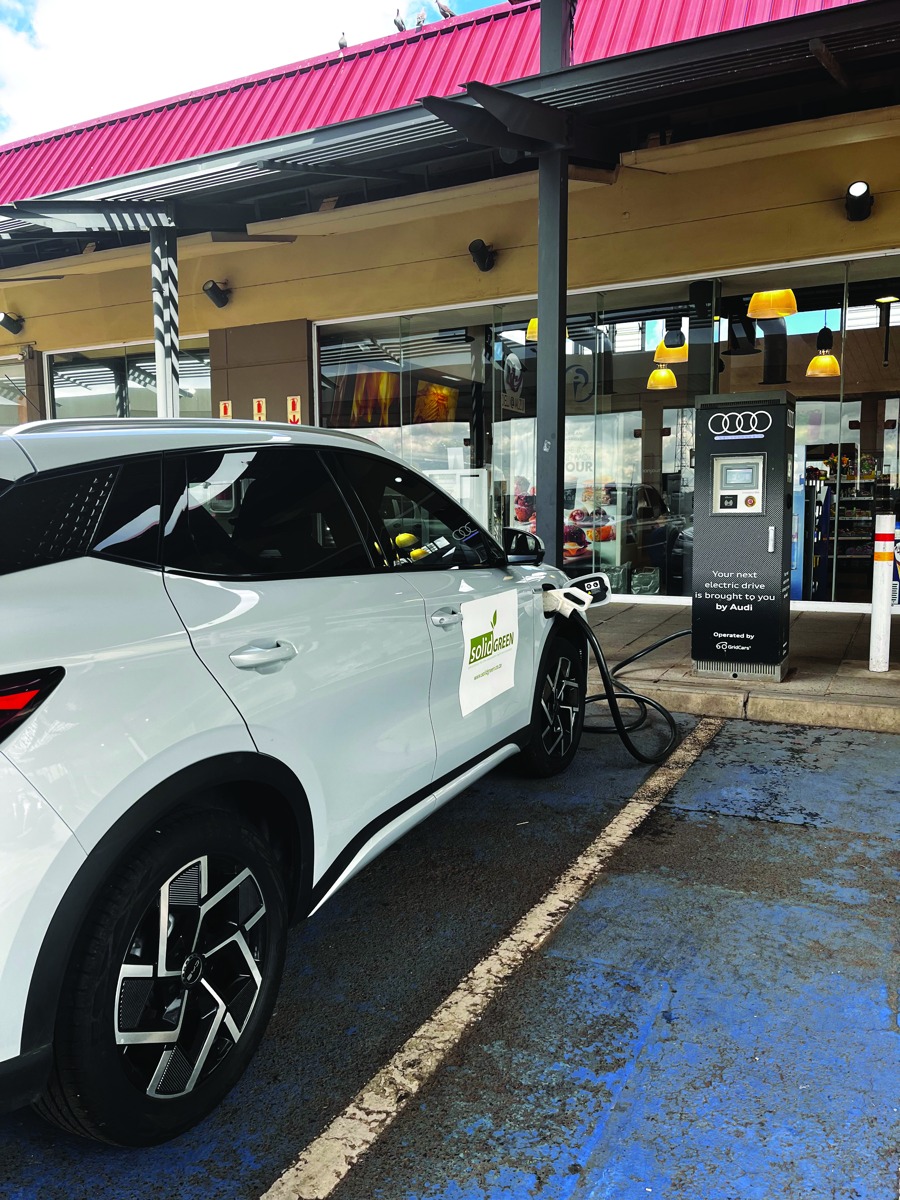
To communicate sustainability authentically, you have to test its limits. Earlier this year, I took our company’s fully electric BYD Atto 3 on a 367km road trip from Johannesburg to Nelspruit. On paper, our “Extended Range EV Trip Plan” was a masterclass in zero carbon travel. In reality, human nature and infrastructure gaps intervened: a leisurely stop to enjoy local wildlife meant we arrived unable to charge before presenting on the “Status of Green Buildings in South Africa.” On the return leg, a charging station went offline mid-charge, triggering a technical support saga that detoured us 30 minutes and added an hour and a half to the drive. Standing at a dark, unresponsive charging bollard, I was reminded that while zero emission technology is viable, its success depends entirely on systemic resilience.
What the science tells us
The transition from fossil-fuelled transit to electric mobility is no longer a niche conversation: it is an essential part of macroeconomics. Research by the Energy Systems Research Group (ESRG) at the University of Cape Town shows that road transport accounts for over 90% of South Africa’s transport emissions and fuel consumption. With our population projected to reach 75 million by 2050, continuing down a “fossil car” path will drive transport energy demand and emissions to unsustainable levels.
There are also realities specific to South Africa. First, more people will be able to afford private cars in the coming years. At present, many do not own cars, not by choice, but owing to economic circumstances. As those circumstances improve with economic growth, more people are expected to shift their primary mode of mobility to private vehicles. The reality is that our public transportation systems are not improving and the desire for car ownership will grow – deepening dependence on carbon-emitting vehicles. Second, the move from fossil-fuel burning cars to electric vehicles (EVs) will not automatically make private vehicles carbon-free, especially because our power is currently generated by Eskom, which relies on coal and places South Africa among the world’s most carbon intensive national grids. For EV infrastructure to truly become carbon-free, the grid itself must also transition to clean energy.
Policy research by Trade & Industrial Policy Strategies (TIPS) shows the transport transition has profound implications: switching from internal combustion engines to EVs cuts road emissions by 34% on the current grid, and this figure jumps to 67% when charged via renewable energy, while eliminating tailpipe pollutants significantly lowers urban respiratory illness, reducing public health expenditures and creating more liveable urban spaces.
From net zero to net positive
At Solid Green, our mobility frontier is shifting from net zero to net positive. Net zero aims to neutralise harm by swapping a petrol car for an electric one and offsetting the footprint. Net positive, by contrast, rebuilds the system to be regenerative, inclusive and resilient. To realise carbon-free mobility in Africa, we must focus on three structural pillars:
Urban form and transit-oriented development (TOD)
As the South African Times Model (SATIM – a “bottom-up energy systems optimisation model that finds least-cost energy pathways to meet future energy demand given various technical, environmental and other constraints”) shows, technology alone cannot solve urban congestion. True mobility requires modal shifts. Prioritising public transit, integrating Bus Rapid Transit (BRT), passenger rail and mini-bus taxi electrification all alongside non-motorised transport can cut motorised travel demand while improving spatial justice for low-income commuters who currently spend over 20% of their household income on transport. If cities make public transport easier, safer and more convenient, dependency on private car use will decline.
Decentralised, solar-microgrid infrastructure
We cannot rely solely on an overburdened national grid. Net positive mobility means building charging networks tied to localised solar PV generation and battery storage. When vehicles aren’t charging, these corporate and municipal microgrids can feed clean energy back into the surrounding community, strengthening local energy security.
Inclusive universal design
A street cannot be considered “green” if it is inaccessible. Just as an EV charger must be operational and backed by reliable networks, our sidewalk infrastructure must accommodate parents with prams, elderly residents and individuals with disabilities. True low-carbon infrastructure seamlessly links neighbourhoods rather than closing them off behind gated barriers.
Walkable streets are the cornerstone of carbon-free mobility, especially in South Africa where almost 80% of the population do not depend on individual private cars. Yes, working towards developing a cleaner, more reliable grid is important, but equal focus should be placed on developing cities and urban spaces that allow people to move freely without combustion-engine vehicles. Johannesburg City has a Complete Streets Design Guideline Manual, an official policy framework aimed at transforming public roads into safe, shared and accessible spaces for all users, not just private vehicles. Implementation of this manual is not mandated; however, the city does have examples of developments that are considering and applying certain elements of it.
A case study – Oxford Parks
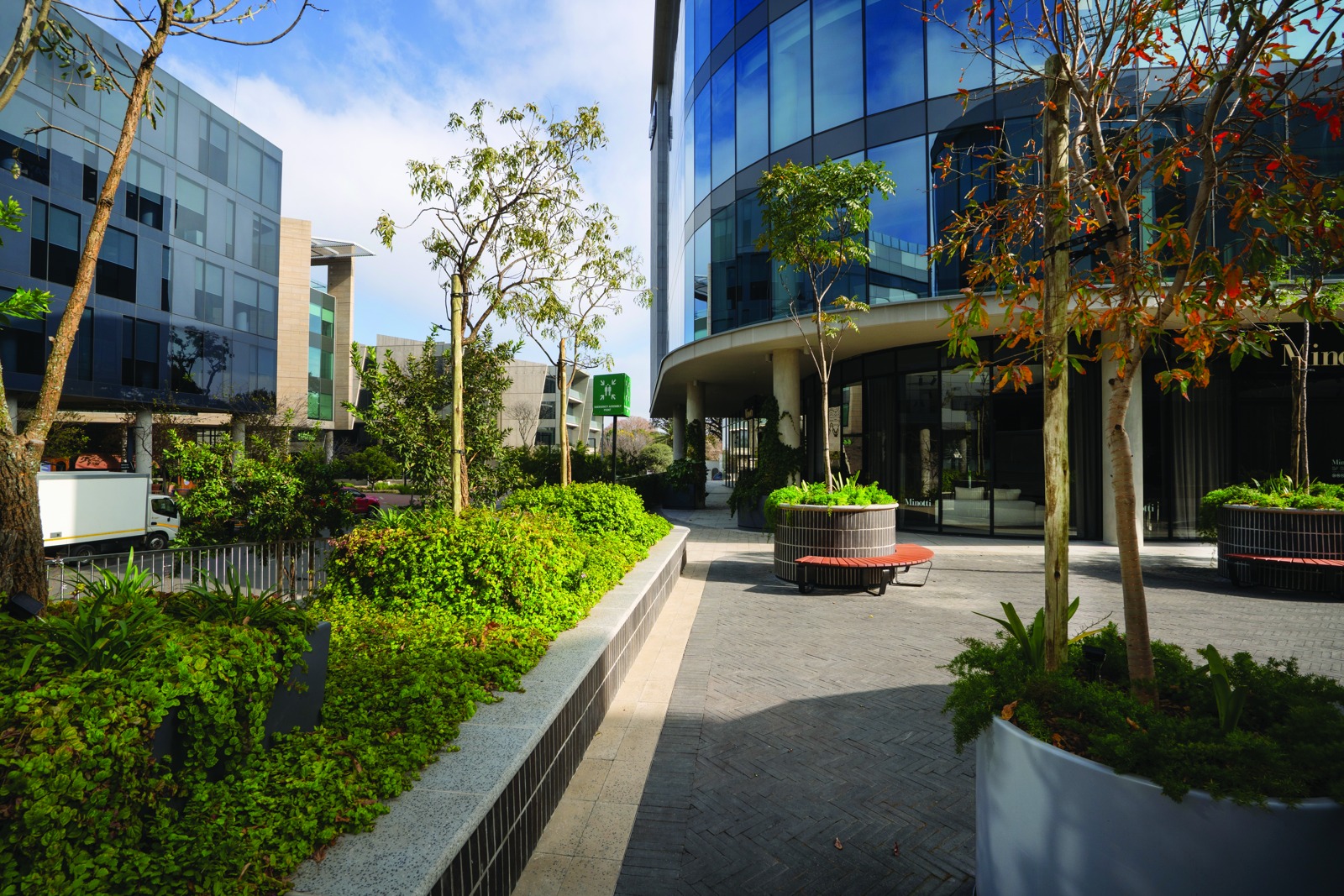
Johannesburg’s Oxford Parks precinct demonstrates how incorporating principles from the Complete Streets Design Manual can shift urban development towards a human-scaled, highly accessible environment. Rather than operating as an isolated or gated enclave, the project actively integrates into its surrounding neighbourhood by prioritising non-motorised transport, widening pedestrian walkways and embedding dedicated public spaces with street furniture and lighting. By breaking larger urban blocks into human-scale segments with pedestrian walkthroughs, activated ground-floor retail and seamless links to transit hubs such as the Gautrain and Illovo Boulevard, the precinct exemplifies a people-focused framework that transforms public roadways into vibrant, safe and walkable shared spaces.
Cities for everyone
Standing at the intersection of architectural design, policy and personal experience, the lesson is clear to me: we cannot build sustainable cities in silos. Whether we are advocating for national EV-manufacturing incentives under the Automotive Production Development Programme (APDP), designing 6-Star Green Star precincts, or simply pushing a stroller down a suburban sidewalk, our goal remains the same. We must move past the comfort zone of basic compliance and build an integrated, low-carbon transport ecosystem that is resilient, accessible and truly net positive for everyone. www.solidgreen.co.za
About the author

Cebisa Mafukuzela is the Sustainability Communications and Engagement Manager at Solid Green Consulting. With over a decade of experience across architecture, urban planning and green building consulting, Cebisa bridges technical design and strategic storytelling to advocate for a resilient, low-carbon built environment. She holds a Bachelor of Architectural Studies, is currently completing her Master’s degree in Sustainable Urban Planning and Development, and serves as an Accredited Professional across multiple GBCSA Green Star rating tools. Combining her background in spatial design with a passion for inclusive urban mobility and indigenous knowledge, Cebisa focuses on translating complex sustainability frameworks into actionable, human-centred practices that drive Africa’s transition toward a regenerative and equitable future.
Main image: Philip Schedler