A legacy of leadership
+Impact sat down with Green Building Council South Africa CEO, Lisa Reynolds, to reflect on a tenure defined by strong teamwork and major growth. Under her leadership, GBCSA has not only been revitalised but has also established a firm foundation for the future of green building in South Africa.
Q: Looking back on your time as CEO, what achievements are you most proud of, and why?
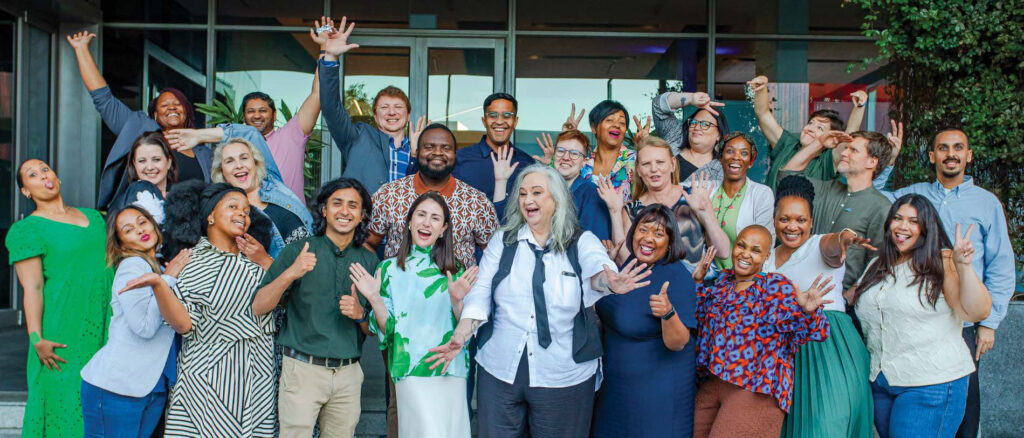
LR: The turnaround of GBCSA that we achieved in the first 18 months is something I am very proud of. What I am most proud of, though, is bringing the GBCSA team together and building it to the cohesive force it is today. The team has stretched and individuals have grown.
It’s been a fantastic thing to witness.
Q: What has been the most challenging part of working at GBCSA – and the most surprising?
LR: The most challenging part of working at GBCSA is that there is so much potential and so many things that we could be tackling, but there are not enough resources or time in our extended working days to do them all. I have learnt to prioritise the things that will have the most impact.
It frustrated me at times that I didn’t have enough hours in the day to reach all potential projects.
The surprising aspect of GBCSA is the disproportionate positive impact it has in the built environment – considering our size. Internationally, GBCSA is recognised as punching way above its weight range.
Q: Can you share some of the biggest learnings from your tenure as CEO?
LR: The wonderful part was all the support I received. Despite some of the flaws within GBCSA, all of our stakeholders wanted us to succeed – they felt that GBCSA was a necessity within the built environment. Everyone gave me space to deal with those perceived flaws, and as the flaws were rectified, their support grew stronger and GBCSA strengthened.
I always knew that playing a role in getting South Africa to a place of sustainability was a task worth doing. To be in my “dream job” doing that very thing makes me a very fortunate person. I love waking every morning and knowing that what I am busy with today is going to make a difference. What a wonderful place to be! When I started as CEO, I knew this was my dream. What surprised me was that it was more. I feel that when I step down as CEO, I will have left a legacy for the next “generation” to build on.
Q: You’ve been a driving force behind energy-efficient standards since 2003. How have these regulations evolved and what impact have they had on South Africa’s built environment?
LR: When I started driving the drafting of energy-efficiency standards for buildings, many people in the building sector thought it was a waste of time. In 2003, electricity was extremely cheap and South Africa had never heard the term “load shedding”. This was despite Eskom reporting that SA would run out of peak load capacity in the next few years. In 2005, the then Department of Energy published the National Energy Efficiency Strategy, and the energy efficiency standards for buildings fitted into it. The first voluntary standards were published in 2008. In 2009, the SABS Committee was asked to draft mandatory standards to accompany a draft regulation. In 2025, most people within this space don’t recall a time when SA didn’t have energy-efficiency regulations and standards for buildings. They were made more stringent in 2021 without much fuss and with little resistance. Imagine how much worse load shedding would have been if we hadn’t started building greener and more energy-efficiently.
Q: What do you see as the biggest challenge – and greatest opportunity – for SA’s green economy over the next decade?
LR: I believe strongly that we have not reached a fraction of the potential within the green economy. The actualisation of exponentially more green jobs is within our reach. The built environment must focus on energy and water-efficiency interventions. The retrofit of these interventions is a massive potential job creator. Efficiency before generation is first prize. If we don’t facilitate these green jobs, our Just Energy Transition (JET) will continue being a talking point without tangible solutions.
Q: What advice would you give the next generation of sustainability leaders?
LR: My advice to the next generation of sustainable development leaders is to always look at the big picture. Sustainability has a knock-on effect, and aspects cannot be looked at in isolation. Seemingly small solutions and incremental changes have the potential to make big differences. I always say that “green is for all”. It is not just the positive effect of greening that is for all. If everyone makes that incremental solution step, climate change mitigation becomes that much more manageable.
Q: After years of service on the GBCSA Board and as CEO, what’s next for you, and how do you plan to stay connected to the green building movement?
LR: My next steps don’t yet have shape or form. I know many people within this space and their sustainability needs vary. My plan is to answer to where I am needed. I have told everyone who asked that I am a phone call away. If you need me, just call.
Lisa Reynolds has served as CEO of the Green Building Council SA since June 2020, although she has been involved with GBCSA since its beginning in 2007. Over the past two decades, Lisa’s advocacy efforts have helped shape the energy landscape in Southern Africa, leading to energy-efficiency transformation. She served on the Regulatory Advisory Committee for National Building Regulation XA (NBR-XA) and is recognised as the driver of the supporting standards for the Regulations – SANS 10400-XA (Energy Efficiency in Buildings). Lisa was the facilitator of the Working Group for SANS 1544 (Energy Performance Certificates). She has assisted the South African Government on their Green Building Framework policies, Energy Efficiency Tax Incentives and Energy Efficiency Strategies. Lisa has won numerous awards in the sustainability space.


