Timber: Driving South Africa’s Renewable Construction Revolution
When one imagines construction materials, concrete, brick, and steel might come to mind. Yet, timber – renewable, carbon-storing, and remarkably adaptable – is emerging as a hero of sustainable building. Globally, and increasingly in South Africa, architects and developers are turning to timber for an array of projects.
From the transformation of underutilised urban spaces into vibrant living environments to large-scale monuments to mass timber, wood’s adaptability lends itself to both new builds and retrofits.

Roy Southey, executive director of Sawmilling South Africa (SSA) notes, “It’s vital for the South African timber value chain to reshape the narrative around the use of wood as a primary construction material for residential, commercial, and public infrastructure projects.”
Southey adds that the awareness around wood’s positive attributes are steadily gaining more momentum. “Long gone are the days where wood was reserved only for log cabins and tool sheds.”
Nature’s carbon storehouse
South Africa’s 1.2 million hectares of sustainably managed commercial plantations are living carbon sinks. As trees grow, they absorb carbon dioxide from the atmosphere, locking carbon into their wood, leaves, and roots. Once harvested, timber products retain this carbon, delaying its return to the atmosphere for decades – or even centuries. Each cubic metre of wood stores roughly 0.9 tonnes of carbon and saves an additional 1.1 tonnes of emissions when replacing materials like concrete or steel – making timber a powerful ally for sustainable construction.
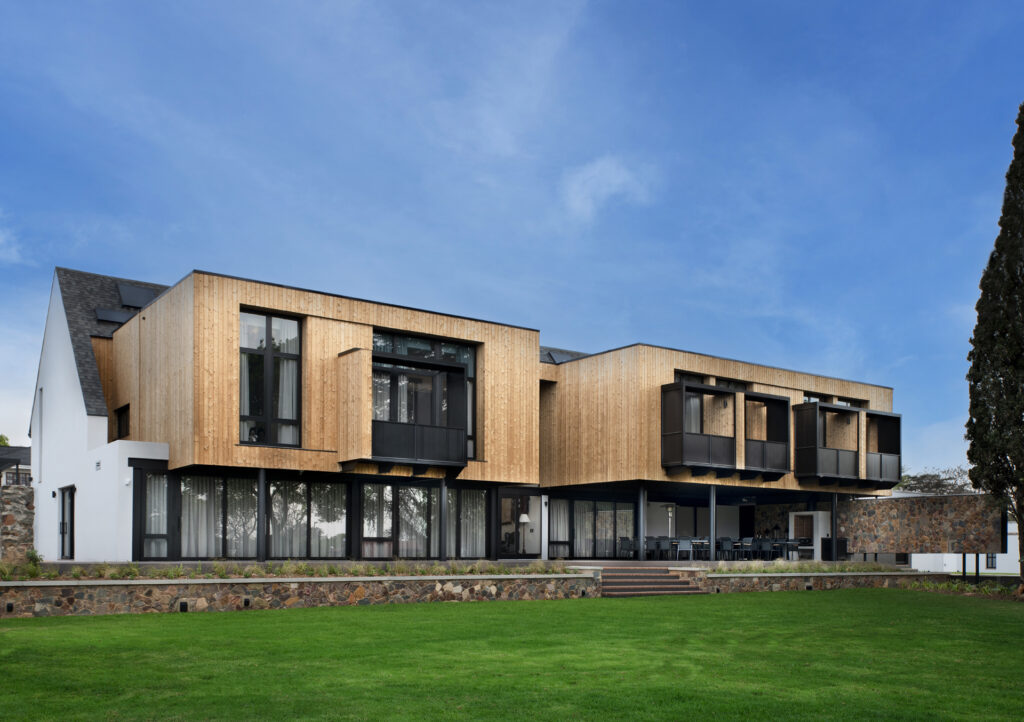
Timber also aligns naturally with circular economy principles. At the end of a timber structure’s life, components can be repurposed, recycled, or even used for bioenergy. This contrasts sharply with traditional materials, which often generate substantial waste and emissions during demolition.
Additionally, timber construction offers potential for ‘greener’ building design:
- Reduced embodied carbon: Timber’s carbon sequestration and substitution benefits drastically lower the material’s overall carbon footprint.
- Lower energy demand: Processing and manufacturing timber products requires less energy compared to other building materials.
- Enhanced indoor environments: Timber interiors provide natural warmth and excellent acoustic performance, enhancing occupant wellbeing through biophilic design – the innate human connection to nature.
Durability and protection
One of the main concerns of architects and builders is timber’s longevity and resistance to the elements. Natural durability varies significantly between species. South African-grown pines and eucalypts, while readily available, generally exhibit low natural durability (classified in the lowest categories for both in-ground and above-ground applications).
Bruce Breedt, executive director of the South African Wood Preserve’s Association (SAWPA), explains that through preservative treatment, even naturally non-durable woods can be transformed into robust construction materials.
“Wood preservatives were among the first biocidal products to be subject to regulation and standardisation in respect of these characteristics and consequently are now accepted as both effective and safe when used correctly and appropriately,” Breedt adds. Treated timber can achieve durability levels suitable for demanding structural applications, from load-bearing walls to exposed façades and outdoor structures. It’s important to note, however, that some species, like imported spruce, are impermeable and cannot be effectively treated.
Breedt notes that choosing species compatible with treatment processes, such as local pine, ensures longevity while retaining sustainability credentials.
Efficient and scalable
Timber-framed housing systems can be prefabricated, transported, and assembled rapidly, reducing construction timelines and costs. Their lightweight nature minimises the need for heavy machinery and makes them ideal for urban infill developments.
“There is also significant economic potential in a greater shift toward timber,” says Dr Phillip Crafford, PhD researcher and project manager at Stellenbosch University. “It would generate opportunities across forestry, harvesting, timber processing, and sawmilling, particularly in peri-urban and rural areas, as well as in the fields of design, construction, and assembly.”
Confidence in the science
Sustainable forestry and wood science underpin the safe, long-lasting use of timber in construction. South African timber products, derived from responsibly managed plantations, comply with stringent local and international standards. Preservative treatments are designed for effectiveness and safety, ensuring that treated wood remains fit-for-purpose without posing undue environmental risks.
“Ongoing research – including studies on timber durability and advancements in mass timber engineering – equips architects and builders with valuable data to guide their material choices. Resources from organisations like Sawmilling South Africa, SAWPA, and Stellenbosch University provide vital insights into species selection, treatment technologies, and design considerations,” says Crafford.
“As a sector, we are ‘growing a solution’—not only for climate resilience but also for housing, a greener society, and a stronger economy,” concludes Southey.


