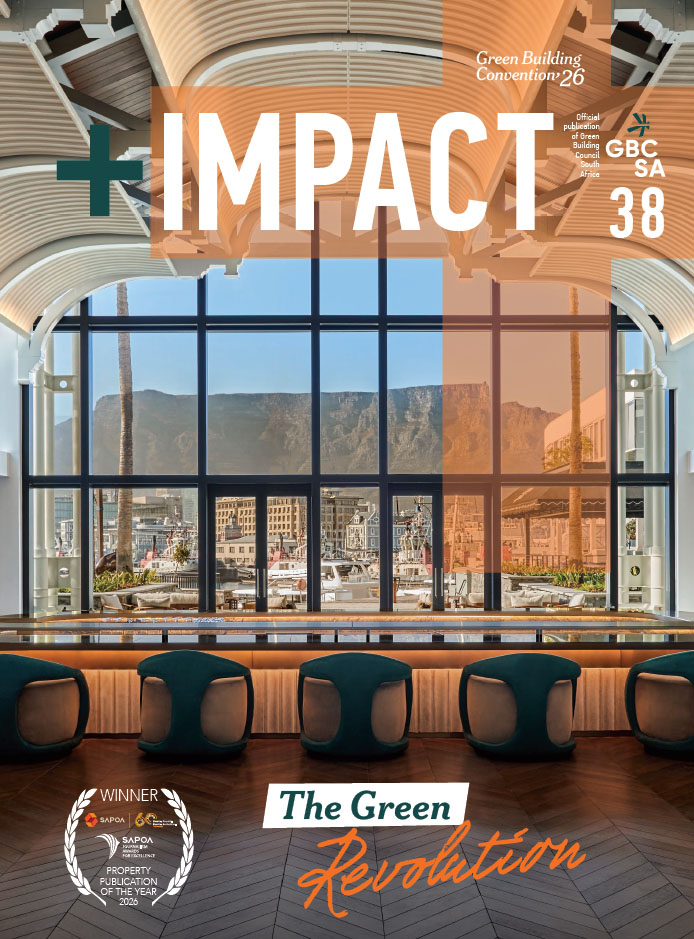
The Green Revolution
The GBCSA Green Building Convention gathers pioneers, leaders and innovators from across the globe. Some of this year’s plenary speakers share how The Green Revolution is inspiring new approaches to sustainability, resilience and transformation in the built environment.
Georgina Smit

CEO, Green Building Council South Africa (GBCSA)
Looking at this year’s convention theme, what green revolutions are you most excited about on the horizon for construction and real estate in South Africa?
There are a number of “green revolutions” that excite me right now, one being the widening range of stakeholder groups taking an interest in green building. We now have the investment community – property funds and asset managers – amongst others, recognising that, in certain circumstances, green translates into better business. We also see government taking note of green, and recognising their own pivotal role. They are increasingly wanting to partner and collaborate with the GBCSA. This broadening of our stakeholder base really excites me because that means that we are moving beyond only built environment professionals to transform a greater part of the supply chain and the market. We have the tools, we have the data that makes the business case for green, and we are ready to support businesses in their sustainability journey.
Another happy green revolution is net zero waste, where there is a massive jump in our industry. We’ve got more than one certification where we’re actually seeing entire retail units achieving net zero waste. There is also the growing acknowledgement of the role that sustainable precinct planning plays in green buildings. Increasingly, developers and project owners are recognising that, yes, they can rate individual buildings, but it’s really about those community and neighbourhood-scale efficiencies and systems that create the type of scale and efficiency needed.
Any advice for new leaders stepping into their first day in the sustainable buildings space?
My advice would be to really focus on using the right language to translate and simplify complex technical terms into very digestible, user-friendly concepts.
That has been a real learning for me: if you are a built environment professional and you have a technical background, you have to explain green buildings as if you’re talking to somebody who has no idea about sustainability. Never assume that someone knows what a green building is, or why sustainability is important.
What is the most urgent change South Africa’s built environment needs to scale up and spread out the adoption of Green?
Most urgently, every building must start its sustainability journey today, so that we can reach our net-zero carbon 2030 and 2050 goals, and divert 1.5° of climate change for South Africa, or at least South Africa’s contribution towards that.
Part of that change is understanding that going green is possible for every building. It is possible, and we have the tools to support everyone’s starting point. It begins with looking at your carbon footprint, knowing what your biggest source of carbon is, and what you can do to decrease that. There are options for every building typology and every industry to take action.
What is the one thing you hope delegates attending the convention this year take away with them in their own sustainability practice?
I hope that they walk away with a sense of personal agency: that what they do matters, that what they do in their everyday job is contributing. We need a lot of different people acting at many different points, and it’s our collective contribution that is going to make a difference and really turn the ship in the right direction.
Our Leadership Awards acknowledge the role of the Accredited Professionals, property developers and project owners. But we’d love to see all delegates leave with an understanding of the valuable role they can play: government at national, provincial and local levels, business and civil society, as well as academia.
No matter what your job or your role is, in whichever sector, you have a role to play and can contribute meaningfully towards transforming the built environment. We need everyone on this journey.
Georgina Smit is an award-winning leader and driving force in green buildings. She served as Head of Technical at GBCSA for five years, where she drove significant year-on-year growth in green building certification, before assuming the CEO role in May 2026. Georgina directs GBCSA’s strategic mandate to mobilise industry leaders, government partners and the property sector towards a net zero future.
Phil Barttram

GBCSA Chair; Founder, Philbar Consulting; Managing Director, Pooled Data Services (Pty) Ltd
Can you comment on the built environment context of 2026 that sustainability has had to be practised within?
It has been an interesting year, with both international and local drivers influencing the adoption of sustainable thinking. Internationally, we have seen a continuation of the United States’ policy pullback on key sustainability issues, while the European Union appears to be taking a more pragmatic approach to sustainability disclosures. What may be perceived as a softening of the need to act sustainably offshore has, however, been countered by a hardening of the regulatory environment locally.
In South Africa, the South African Reserve Bank’s prudential reporting requirements have pushed banks and insurers towards a deeper understanding of their material environmental and social risks. In addition, the International Sustainability Standards Board (ISSB) working group, which includes the Companies and Intellectual Property Commission (CIPC) and National Treasury, has gained traction in its plans for South Africa’s adoption of International Financial Reporting Standards (IFRS) Sustainability Disclosure Standards S1 and S2. Within this context, there has been a telling acknowledgement by built environment decision-makers that they can make a real difference, environmentally but, also on the socio-economic issues within the communities that surround their properties.
You describe yourself as a “sustainable capitalist”. How does that philosophy influence the way you approach real estate investment and sustainability strategy?
It may sound trite, but I fundamentally believe that sustainability and capitalism are not mutually exclusive. If we can improve the way we value sustainability-related risks, we can improve the way we allocate capital. Over time, that should help us build a better world. I am not naive to the size of the task. Traditional valuation models are deeply entrenched and have been around for centuries. However, there is a growing acknowledgement that value is created from much more than financial and manufactured capital alone.
For me, being a sustainable capitalist means recognising that long-term financial value depends on how well we manage all forms of capital: financial, physical, human, social and natural. Sustainability is therefore not separate from investment strategy. It is becoming an increasingly important part of how we understand risk, return and long-term value.
With more than 30 years in financial services across a range of countries, what do you see as the biggest challenge and the biggest opportunity for the uptake of green buildings in South Africa today?
I would say the biggest challenge is having the courage to lead when a new paradigm starts to emerge. John Maynard Keynes said: “The difficulty lies not so much in developing new ideas as in escaping from old ones.” That feels relevant to where we are today. The investment thesis is moving from a two-dimensional paradigm of risk and return to a 3-D paradigm of risk, return and impact*. Investors who are courageous enough to value and act on allocation models that recognise this new paradigm should, over time, benefit from the upside. The opportunity is that green buildings are no longer only about doing the right thing. In South Africa, where energy, water, infrastructure and social inequality remain very real issues, they are about building more resilient, efficient and investable assets.
What’s your best piece of advice for making the most of a delegate’s Green Building Convention experience?
There’s a massive transfer of knowledge at the GBCSA Convention, and it’s impossible to physically attend every session. So take the time to choose carefully, before the day, what topics and speakers interest you most. GBCSA brings together a wide range of like-minded individuals and specialist expertise – use that to your advantage. Speak to people and gather as much insight and knowledge as you can while you are there. The real value of the Convention is not only what happens on stage. It’s also in the conversations between sessions, the relationships that are built, and the ideas that delegates take back into their own organisations.
Phil Barttram is a thought-leader and independent consultant on real estate investment and sustainability strategy. As a self-proclaimed sustainable capitalist, with 30+ years in financial services across South Africa, the UK and the Middle East, Phil helps embed decision-driven data insights into their real asset investment strategies.
He holds an MBA, is Chair of GBCSA and a member of the SA REITS Association Research Committee. Phil is the Founder of Philbar Consulting and Managing Director of Pooled Data Services (Pty) Ltd.
Reference: Thinking Ahead Institute
John Vlismas
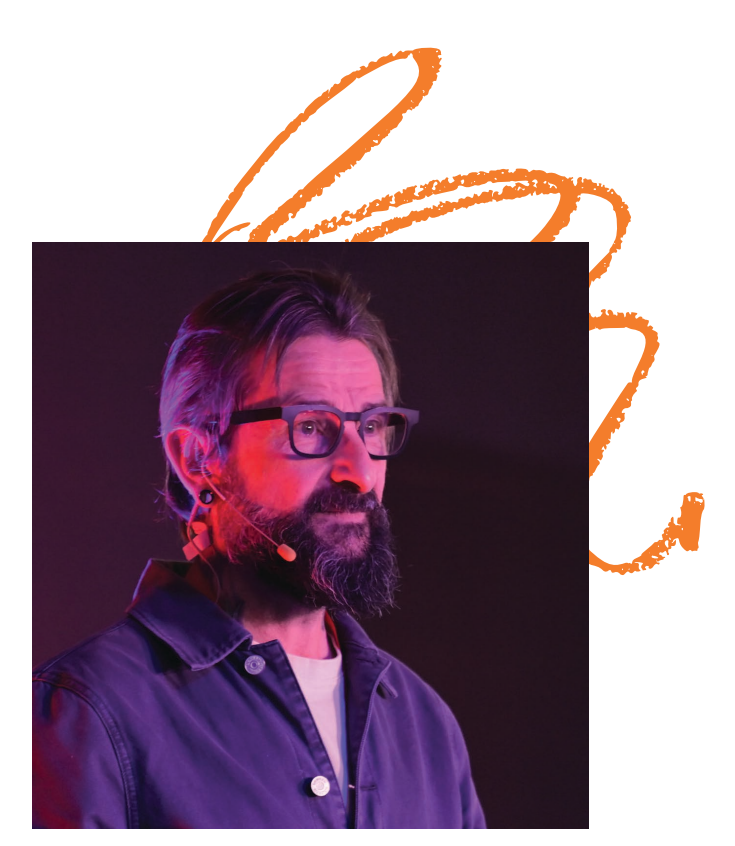
Head of Strategy at OGO Creative; academic;
keynote speaker
What does the convention theme ‘The Green Revolution’ mean to you, and how do you see its ideas connecting with the personal and organisational transformations you speak about?
Any decision to be more aware of the ecosystem that nurtures us – environmental, social, physical, emotional, psychological – is better than being numb to it. Awareness of the whole is for me a more peaceful and sustainably happy way to use the heartbeats we have been given. Life is a collective process – not one organism straining their glory gland to put on a show.
Your plenary address explores leaving comedy and facing a personal crisis. How did that process of dismantling and rebuilding influence the way you now think about leadership and equity?
I feel we overstate the value of what we quantify as identity on our personal balance sheets. Ego is a liability that I have treated as an asset. That led to harm. By realising that my inherent value lies in my ability to be part of a community, I’m better able to appreciate that everyone is trying to figure out who they are. I can stop reacting to their attempts, and try to act on our shared journey.
Stepping away from comedy meant redefining yourself. How has that shift in identity changed the way you connect with people and approach your work today?
Letting go doesn’t have to mean grasping for another identity. Closure isn’t the prize we’ve been led to believe. Learning to cherish and live through liminal phases – crossings – is an unsettling that I need. Life isn’t certain. The “numbers” can and do lie. So I try less to leave the present in search of memories or hopes. I try to put things down and listen to others more. I try to recognise when I get overwhelmed by false urgency – I don’t get it right every time, but when I can, life gets a little deeper and higher in resolution. A mentor told me that “there is nowhere to stand”. Leaving the insecure identity of comedy was difficult and illuminating.
What do you hope audiences will carry away from your talk in terms of their own personal journeys and the way they reflect on themselves?
We have a better chance of recognising who we really are if we let go of what we say we are. The stories that shape us are not necessarily a function of truth. Once we see ourselves, we can see others through a cleaner lens – aspects of ourselves – and so we can connect honestly with them.
John Vlismas is a South African strategist, academic and keynote speaker whose work sits at the intersection of behavioural insight, leadership and communication. He is Head of Strategy at OGO Creative, the agency he co-founded, and lectures at Henley Business School, where he earned his MBA and led the marketing team through the shift to virtual learning during Covid-19.
His speaking work translates complex research on culture, strategy, and leadership into clear, usable frameworks for corporate audiences. Before moving into strategy, John spent years as an award-winning stand-up comedian. He is public about his ongoing recovery from drug and alcohol addiction and an eating disorder, and for the past two years has hosted and delivered the keynote at GBCSA’s annual Green Building Convention.
Adam Levy
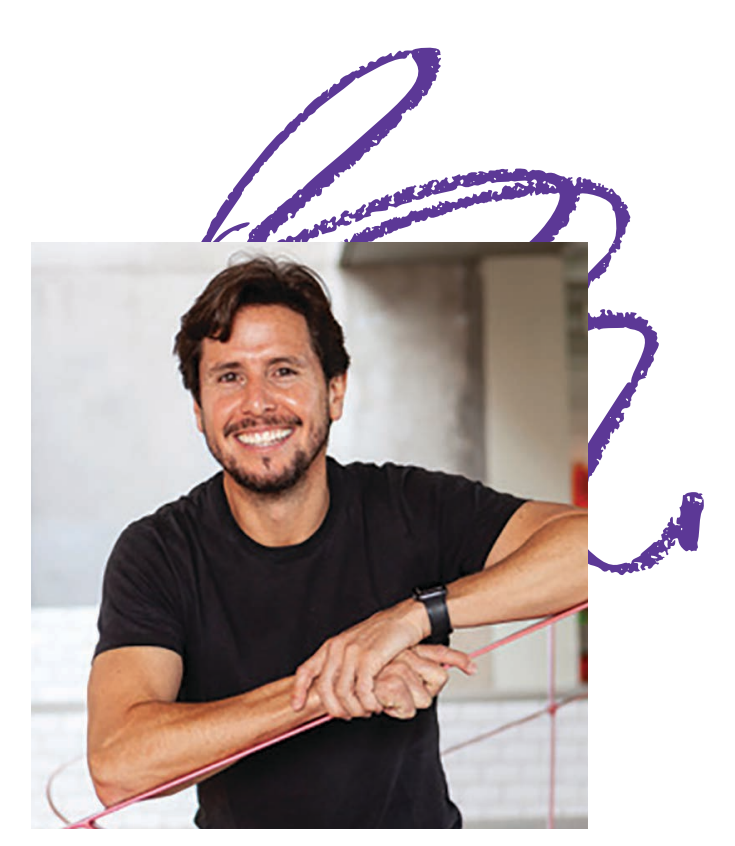
Founder of Play Braamfontein; entrepreneur; designer; urban place-maker
What is Play Braamfontein and how does it reflect your vision for property as more than just buildings?
Play Braamfontein is the culmination of more than two decades of investing in, restoring and programming a collection of buildings and spaces in Johannesburg’s inner city. I have never really viewed property as being about buildings alone. A building is simply the physical infrastructure. Its real value comes from what happens inside it, around it and between it and the street. That philosophy has shaped Play Braamfontein.
We have combined property with hospitality, culture, food, music, events, markets, media and public life to create a precinct rather than simply a portfolio of real estate. For me, successful property is ultimately about human experience. If people want to come, stay, meet, work, eat, listen to music and return, the buildings become relevant. Property provides the framework; people and experience create the place.
You’ve helped transform Braamfontein into a vibrant cultural district. What does this journey reveal about creative place‑making?
Braamfontein taught me that people respond incredibly quickly when they are given a reason to believe in a place. When I started, much of the conventional wisdom was about what was wrong with Johannesburg. My approach was to focus instead on what could be created here. We brought together architecture, food, music, retail, markets, public space and some of the city’s most interesting creative people.
Creative place-making can change how people perceive an entire neighbourhood. It creates reasons to cross boundaries that people otherwise wouldn’t cross and allows very different communities to occupy the same space. That shared experience builds relevance, confidence and ultimately, investment. Culture is not an accessory to regeneration; it can be one of its most powerful catalysts.
What challenges did you face in Braamfontein and how did you overcome them to keep the vision alive?
Urban regeneration is never linear. Cities move through cycles and Johannesburg has certainly tested that belief. It often feels like my story is more about fortitude and unrelenting resilience. For almost 25 years I have continued to experience changing perceptions of the inner city, economic downturns, infrastructure challenges, declining municipal capacity, the closure of Maboneng and COVID, which effectively stopped the very human interaction on which much of our precinct was built. The temptation during difficult periods is to retreat. I chose instead to keep adapting. Uses changed, businesses evolved and spaces were reinvented. Neighbourgoods Market became The Playground; buildings acquired new purposes; and projects such as Hugh’s jazz club introduced another reason for people to experience Braamfontein again.
How do you see experiential urban spaces influencing the way South Africa’s cities evolve over the next decade?
I think the future of our cities will depend less on building more and increasingly on making much better use of what we already have. South Africa has extraordinary existing buildings, infrastructure and urban neighbourhoods that have lost relevance or become disconnected from the people around them. Reusing those assets intelligently is both an environmental opportunity and an urban one.
But adaptive reuse alone isn’t enough. People increasingly choose places because of how those places make them feel. The successful precincts of the next decade will mix work, culture, hospitality, entertainment, retail and public life rather than separating them into single-purpose environments. For me, sustainability also means creating places that people value enough to sustain. When a building can evolve, accommodate different uses and remain relevant across generations, we preserve embodied value while strengthening the city around it. The greenest opportunity may often be the city and the buildings that already exist.
Adam Levy is a Johannesburg-born entrepreneur and urban place-maker who has spent more than two decades investing in and reimagining the inner city of Johannesburg. Through Play Braamfontein, he has transformed a collection of buildings and public-facing spaces into one of Johannesburg’s most recognisable cultural precincts.
His projects include the restoration of the Alexander Theatre, the creation of Neighbourgoods Market and its successor The Playground, and most recently Hugh’s, a jazz club developed in partnership with the Hugh Masekela Heritage Foundation. His approach is rooted in adaptive reuse, international standard design, cultural programming and the belief that property is not simply about buildings but about creating places people choose to inhabit, experience and return to.
Otsile Nkadimeng

CEO and co-founder of Pako; co-host of SMWX; climate and democracy advocate
What inspired you to co-found the Sundial Movement – a peer-to-peer support and knowledge-sharing platform for high-school climate activists?
Sundial came out of a very personal problem. I began organising in the climate space as a teenager, often the youngest person in every room. Surrounded by university students and professionals, I learned a great deal, but I was isolated. Nobody else was balancing advocacy with the 2pm school bell and homework. What I needed were peers who resonated with that and peers who knew what worked. So my co-founder Pètra de Beer and I built what we’d been looking for. We shared knowledge of organising within basic education, holding commitments from morning to afternoon, and being taken seriously without a degree.
Sundial became the vehicle: a place to share best practice and for young people to find each other and stop feeling alone. Young people have the most to gain if South Africa acts decisively on climate change, and the most to lose if we fail. That asymmetry is the entire case for youth activism, and it is not sentimental – it’s arithmetic. But it only works when the vehicle is organic and youth-owned. A space young people curate, own and take responsibility for improving produces leaders.
Through SoWeVote, you’ve engaged young people in democracy. Why is civic participation essential for tackling challenges such as climate change and inequality?
Civic participation is the mechanism by which a society builds enough consensus to do anything genuinely difficult. Policy, budgets, legislation, delivery – all sit downstream of it. In a moment this disorienting, that mechanism is under strain, and young people are often the first to fall out.
That’s the gap SoWeVote was built into. Most people don’t disengage because they don’t care, but because the system is hard to read: who stands for what, what’s being decided, when your vote matters. Answer those questions clearly and frustration becomes participation. So our work is less about persuading people to care and more about making democracy legible. That’s the thesis of SoWeVote – and the link to tackling climate change and inequality.
As a leading organiser of Fridays for Future South Africa, a youth-led climate justice movement, what lessons from grassroots climate strikes can be applied to professional sectors and institutions?
I describe my time at Fridays for Future as a baptism by fire. Still in high school, I had to confront the realities of organising in South Africa – not theory, but practice. The core lesson was that grassroots work must go to the communities most affected, those least likely to be heard. Their lived experience is the bedrock of why the issue matters, and separating the argument from the people weakens it.
For professional sectors, that translates into one rule: never discuss a community without them, and wherever possible, have the conversation where they are. You learn things no briefing can give you. The same applies in entrepreneurship: product market fit isn’t found in a boardroom, but by being on the ground with those you’re building for.
Otsile Nkadimeng is a South African founder and civic advocate. He is CEO and co-founder of Pako, an AI-native financial wellness platform; Board Chair of SoWeVote, a non-profit that makes democratic participation easier to understand and act on; and co-host of SMWX, a political and current affairs podcast.
Samantha Skyring

Founding CEO of Oryx Desert Salt; salt visionary; health advocate
Your journey began with a 120km walk through the Namib Desert – how did that experience shape Oryx Desert Salt?
That walk through the Namib Desert in 2000 was one of those experiences that stays with you. Over seven days towards the Skeleton Coast, I had extraordinary encounters with wild oryx, or gemsbok – powerful animals perfectly adapted to one of the harshest environments on earth.
Years later, when building the brand around Kalahari Desert Salt, those memories returned. I discovered the oryx can survive long periods without water, yet not without salt, which provides essential sodium, minerals and trace elements. That connection felt deeply meaningful. The oryx became our name and symbol – a reminder of resilience, adaptation and the remarkable resources within our South African landscape. From that experience came the foundation for a global brand.
Why is ethical sourcing and community empowerment so central to your business model?
For me, ethical sourcing is about recognising that every business transaction can create opportunity for others or act as an agent for positive change. At Oryx, we deliberately choose suppliers where our growth supports theirs. Our chilli salt is one example – chillies are organically grown by gogos (grandmothers) in the Gugulethu area (Cape Town), creating income for small-scale farmers through backyard farms. Our cotton bags are made by a women’s home-industry group that has grown from one to seven members as our business expanded. Our refillable packaging reflects the same philosophy: reducing waste and encouraging reuse.
Business is part of a global ecosystem, and success means creating value beyond the product – supporting people, strengthening communities and caring for our planet.
Oryx Desert Salt aims to “work in harmony with nature”. How does that principle guide your decisions?
For me, working in harmony with nature means recognising we are not separate from it – every decision has an impact. Nature has always been a teacher, particularly the desert, where you see resilience, balance and survival with very little. It makes you think differently about what you need and how you use what you have. At Oryx, we ask not only, “Does this make commercial sense?” but also, “Is this the right thing to do, and what will the consequences be?” That thinking influences what we source, how we package, who we work with and how we grow. Good businesses should create value without continually taking more than they give back.
Samantha Skyring is the founder of Oryx Desert Salt, a sustainable brand sourcing unpolluted salt from an ancient underground lake in the Kalahari Desert. With a mission to eliminate microplastic laden salts, her innovative approach includes 100% plastic-free packaging and refillable grinders with ceramic mechanisms that reduce waste and avoid grinding plastic into food. Beyond entrepreneurship, Samantha is a sought-after speaker and advocate for health, sustainable business and conscious living. She inspires audiences worldwide to reconnect with the earth’s elements and elevate well-being through mindful choices, setting new standards for sustainable, health-focused products while empowering others to make planet-friendly decisions.
Lorne Sulcas
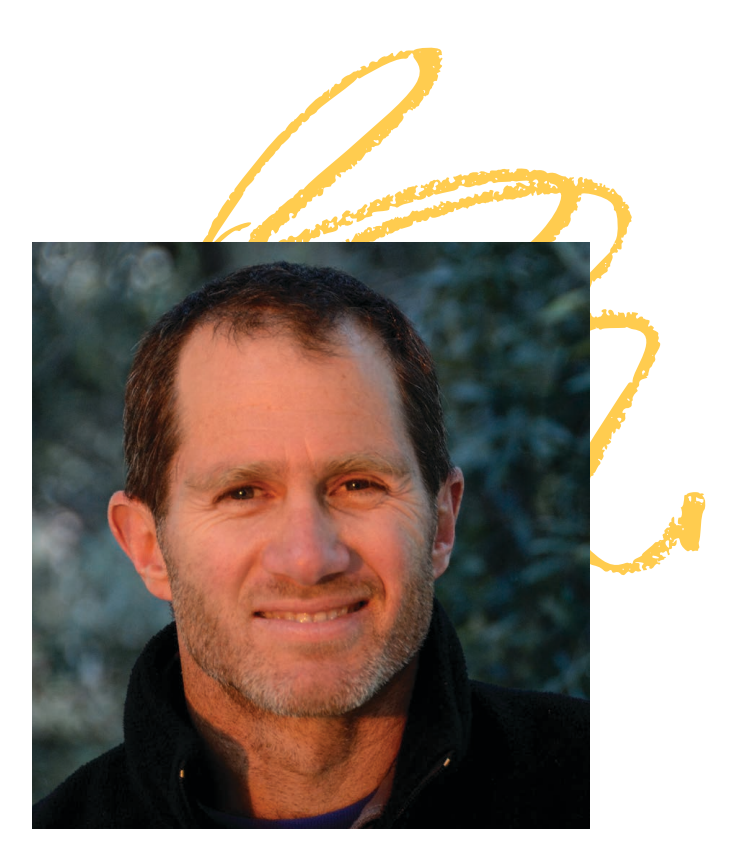
“The Big Cat Guy”; motivational keynote speaker; wildlife photographer
What prompted you to take lessons from big cats in the wild and bring them into the corporate world?
Before becoming a game ranger, I was fortunate to spend several years as a management and training consultant in the South African corporate “jungle”. Soon after I started working as a bush ranger-safari guide, I became fascinated with the success strategies of lions, leopards and cheetahs in the face of brutal competition, and started an empirical research project to learn more about their behavioural ecology. I immediately saw the powerful parallels and patterns echoed in the concrete and “real” jungles around, for example, resilience to change, what makes a high-performance team, leadership strategies and surviving competition. Understanding the power of these million-year old patterns and behaviours in nature, and the exciting appeal and intrigue of the big cats, I realised how powerful these lessons could be in helping people in teams and organisations Thrive in a Wild World™!
What’s the most surprising lesson about teamwork or resilience that audiences don’t expect to learn from big cats?
The ability of the big cats to adapt to change is one of the most powerful, fascinating and underrated lessons I continue to observe and speak about. Change in the animal kingdom is just as ubiquitous and threatening as in the human wild world. For the big cats, constantly changing seasons, conditions, habitat and prey means that every hunt, every day is different. As in the concrete jungle, only those that can adapt will survive. Lions can modify their hunting modus operandi by shifting hunting roles within in the team, prey selection and even team size according to their immediate context. The leopard’s opportunistic solitary hunting, diverse habitats and hugely varied diet make it arguably the most adaptable large carnivore on the planet, able to thrive in ecosystems ranging from desert to bushveld to montane biomes.
Was there a single moment in the wild that shifted how you think about leadership and success?
Seeing a cheetah mother actively empowering and patiently teaching her cubs how to hunt and leading by example was an epiphany for me about the power of empowering and visionary leadership. In low-risk situations the cheetah mom will intentionally catch small prey like a gazelle lamb and instead of killing it, she will release it near the cubs for them to chase it. She repeats this process multiple times over several months, letting the cubs fail, until eventually they master the skills necessary to hunt for themselves. It reinforced for me how there is no success without failure; success is a process, with ups and downs, achieved through visionary leadership and by continuously “failing forward”.
Lorne Sulcas is internationally renowned as “The Big Cat Guy”, a unique authority and motivational keynote speaker. Since 1996, he has spoken on the world’s largest stages across the globe, addressing organisations from NASA and Sony to The World Bank, and has appeared on CNN. A former game ranger, safari guide and internationally awarded wildlife photographer, he brings a distinctly African perspective. In his presentations, Sulcas draws on the million-year-old success strategies of Africa’s big cats to reveal powerful lessons on how to thrive in a challenging, changing world.
Sumayya Vally

Founder and principal of Counterspace Studio; honorary Professor of Practice
Counterspace Studio has become known for blending research, storytelling and design. What makes it different from traditional architectural practices?
Counterspace began in Johannesburg, and the practice still carries the city’s way of making architecture: through improvisation, adjacency, contradiction and multiple forms of knowledge occupying the same ground. We see architecture as a cultural practice, where research is already design. A project might begin with an oral history, a song, a ritual, a migration route, a recipe or a fragment of architecture outside the canon. I am particularly interested in the architectures people have made for themselves – spaces born of necessity, ceremony, trade, faith or collective life. A hair salon can contain a geography of migration; a market can be an archive.
The work of Counterspace is to take those forms of intelligence seriously and allow them to generate architecture. Sometimes the result is a building. Sometimes it is a landscape, a bridge, a piece of furniture, a gathering or an institution. I think of architecture less as the production of objects and more as the construction of relationships: between people, histories, materials, territories and ways of being together.
You were the youngest architect commissioned to design the Serpentine Pavilion in London. What story were you telling through that project?
I spent time looking at spaces that have held communities through migration and displacement – bookshops, restaurants, markets, places of worship, music venues and community centres. Many were architecturally modest yet culturally immense. The Pavilion emerged from fragments of these places. Rather than a singular object in Kensington Gardens, I wanted an architecture with a diasporic condition, existing in several places at once. Fragments of the Pavilion travelled back into the city – a bookshelf at New Beacon Books, a stage at the Tabernacle, a seat at the Albany, a radio podium at Valence House – entering relationships with the communities from which the research had come.
So the Pavilion was never entirely contained within the Pavilion: its architecture was distributed across London. That was important to me because it questioned where architecture begins and ends. The central structure needed no furniture placed inside it. Its edges, steps, thresholds and surfaces already invited sitting, speaking, performing, eating, waiting, meeting. Architecture became something completed through occupation.
Perhaps the story I was trying to tell was that a city is held together by many small architectures of gathering, some visible and some almost invisible. The Pavilion was a way of making those structures briefly legible, and then allowing the architecture to travel back out into the city again.
Johannesburg has been a strong influence on your work. What is it about the city that continues to shape your design approach?
Johannesburg is a city of profound complexity. I grew up moving between Laudium, the Joburg Library and my grandfather’s stores on Ntemi Piliso Street, where walking those streets revealed segregated worlds and shaped my understanding of space and power. Joburg is gritty, ruthless and fast in the nicest and meanest possible ways – both burden and opportunity. Its histories of exclusion mean there is work to do at every turn yet it remains vibrantly creative.
The city taught me that space is never innocent: apartheid organised bodies, land, infrastructure and proximity through architecture and planning, but Johannesburg constantly exceeds the plans made for it. Buildings are appropriated, streets shift character and migrant communities bring other geographies into the city. Even the Highveld landscape transforms with a storm. Joburg taught me to embrace hybridity, contradiction and architecture that changes through occupation and exceeds expectation.
Sumayya Vally is the principal of Counterspace, an architecture and research practice exploring hybrid identities and spatial relationships, with a particular interest in the complex relationships between territories and places. A WEF Young Global Leader, TIME100 honoree and Art Basel Medallist, she is the youngest architect commissioned to design the Serpentine Pavilion in London. Vally is Resident Architect at Ibraaz, which she imagined as a living, evolving space shaped by the artists, collaborators and communities that gather there. Her practice is in constant conversation with her teaching at leading architecture schools, including Columbia’s Graduate School of Architecture, Planning and Preservation (GSAPP) and The Bartlett School of Architecture, University College London (UCL).
Elizabeth Wathuti
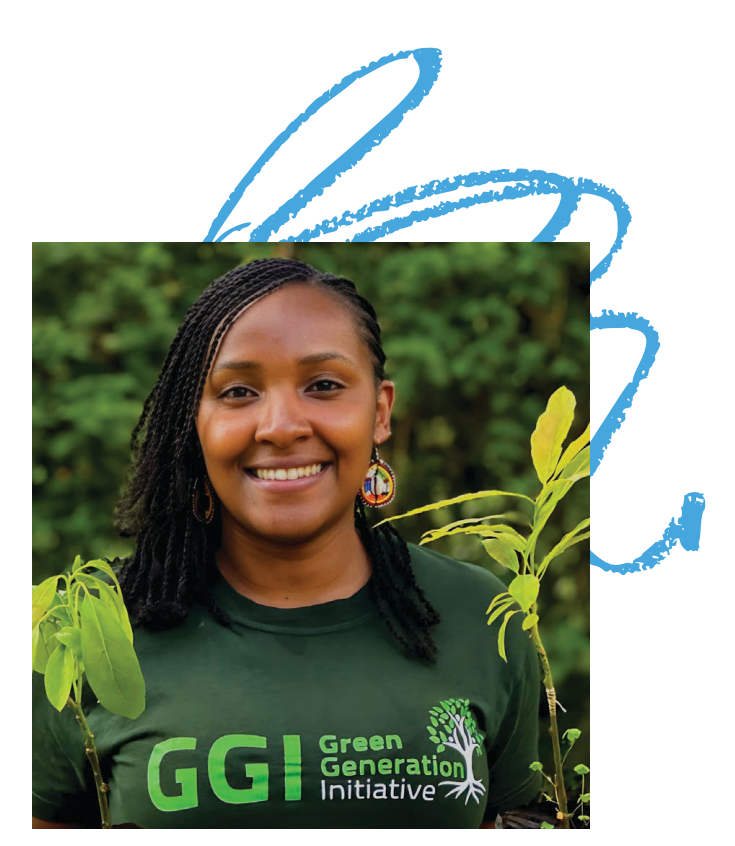
Founder and CEO of the Green Generation Initiative (GGI); global environmentalist; young climate leader
You founded the Green Generation Initiative at just 21. What has this journey taught you about the power of youth-led climate action?
This journey has taught me that meaningful change is built through consistency. I founded the Green Generation Initiative as a university student with a simple desire to nurture more young people to care for nature and take practical action. What began with tree growing and environmental education has grown into work reaching thousands of schools, farmers and communities across Kenya, with millions of trees grown to maturity restoring landscapes, while at the same time supporting young climate entrepreneurs across Africa.
It has also shown me that young people are already leading and building solutions in their communities. They bring urgency, creativity and the courage to challenge approaches that are no longer working. But passion alone is not enough. Young leaders also need trust, resources, mentorship and a meaningful place at decision-making tables and more people who are willing to back their solutions to move from early traction to scale. When their commitment is matched with sustained support, local ideas can grow into lasting solutions that strengthen communities and improve livelihoods.
At COP meetings you’ve spoken about “loss and damage”. How do you explain this concept to everyday people and why does it matter so much for vulnerable communities?
Loss and damage describes the harm caused by climate change that communities can no longer prevent or fully adapt to. It is the farmer who loses an entire harvest after prolonged drought, the family displaced by floods with entire villages wiped out by a storm, or a community whose water source disappears. Some losses are economic, such as destroyed homes, crops and infrastructure. Others cannot easily be given a price, including the loss of lives, culture, ancestral land and a sense of belonging. It matters because the communities experiencing the worst impacts have often contributed the least to the climate crisis and have the fewest resources to recover.
Climate justice therefore requires more than sympathy, it means making reliable and accessible finance available to affected communities so they can rebuild their lives with dignity. It also means ensuring that support reaches people directly, without creating more debt or burdens for countries already struggling.
Kenya’s reforestation and community projects have had a huge impact. What lessons from these efforts do you think could inspire other countries facing climate challenges?
One of the most important lessons is that restoration cannot simply be about planting trees; it must be about growing trees and sustaining the people who care for them. Communities need to be involved from the beginning, including in identifying local priorities, selecting suitable species and monitoring survival. Restoration works best when people understand its value and also experience tangible benefits through improved water security, food, incomes and livelihoods.
Our work with schools, farmers, women and young people has also shown that local knowledge must be respected and combined with science. Partnerships are equally important. Governments, communities, businesses, the private sector, philanthropy and civil society each bring different resources and capabilities.
Countries should therefore avoid measuring success only by the number of seedlings planted. The real measures are how many trees survive, whether ecosystems recover, whether water sources improve and whether local communities become more resilient and prosperous.
Elizabeth Wathuti O.G.W. is a Kenyan environmentalist, climate leader and founder and CEO of the Green Generation Initiative (GGI), one of Africa’s fastest-growing youth-led organisations advancing tree growing, climate education and community resilience. A recipient of Kenya’s Head of State Commendation in the Order of the Grand Warrior and recognised as a National Hero by the National Heroes Council, she was named among the TIME 100 Most Influential Climate Leaders of 2025. Wathuti is a Commissioner on the Global Commission on the Economics of Water and has received numerous international accolades, including the TIME Impact Award, Wangari Maathai Scholarship and Africa Green Person of the Year. Through her leadership and advocacy, she inspires youth-driven climate innovation and locally led environmental restoration.
Main image: Austris Augusts / Unsplash.