Sustainable Luxury
Club Med South Africa’s Beach & Safari Resort celebrates the very first 4-Star Green Star V2 Design certification awarded under GBCSA’s Green Star New Build and Major Refurbishment V2 Pilot tool – a proud industry first for the country’s next-generation green building framework.
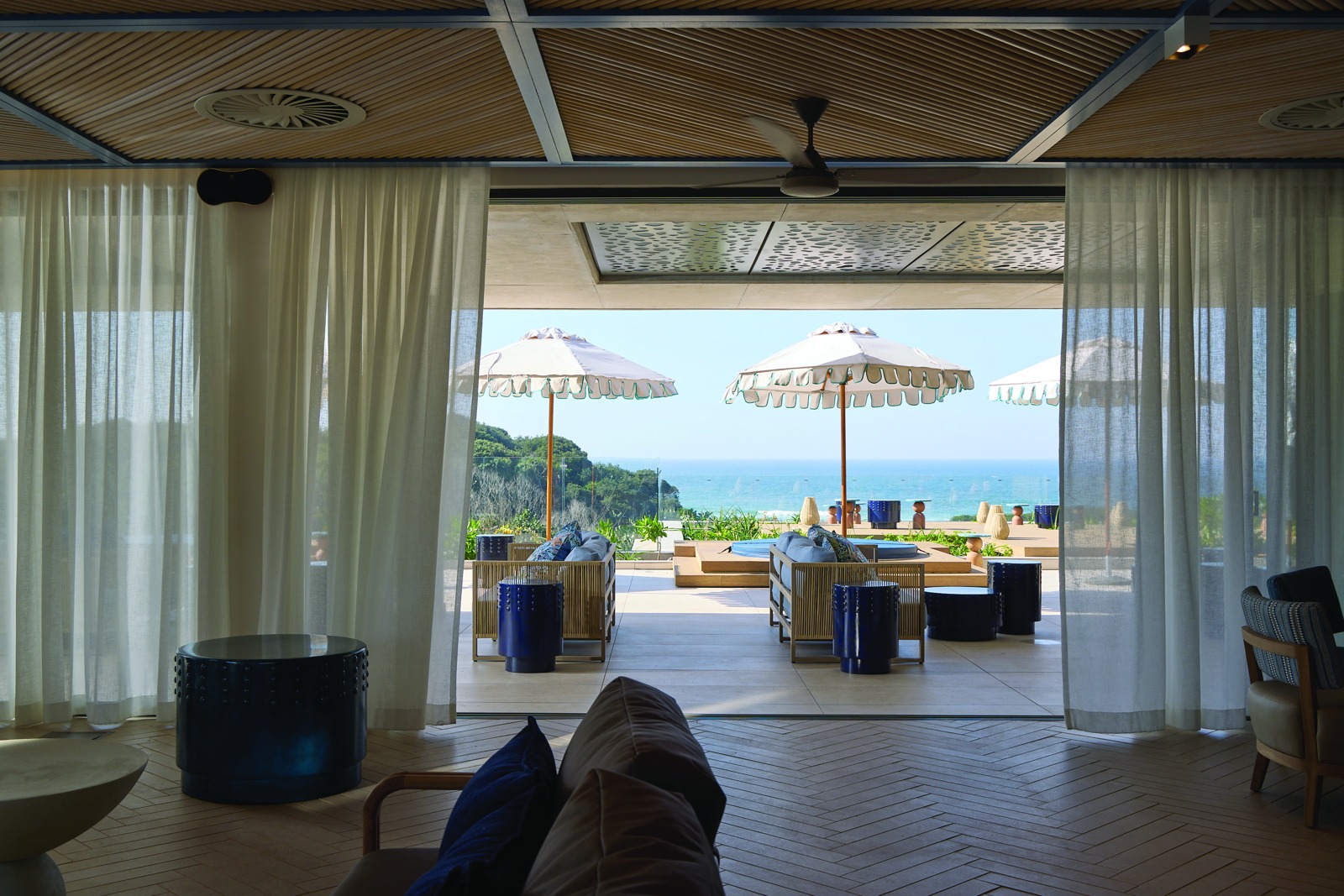
The very first Club Med resort in South Africa – and the first Beach & Safari Resort concept in the world – is open. Club Med SA is perfectly situated at Tinley Manor beach on the KwaZulu-Natal (KZN) North Coast, or Dolphin Coast, as it’s descriptively known. The resort was developed by Collins Developments, working closely with M3 Africa as project managers, and Solid Green Consulting as sustainability consultants. After two years of construction and many more of design and planning, Club Med SA marks a memorable milestone in sustainable tourism and hospitality for the region. The resort’s pitch-perfect pairing of a beach and safari experience offers international visitors a truly world-class vacation, showcasing KZN’s superb natural landscapes, beach, sea and wildlife offerings. Located about a half hour drive north of King Shaka International Airport on the coast, it also offers a Big Five safari component (a four-hour drive north takes guests to Pongola’s Vikela Safari Lodge, a luxury tented camp in an 18 000ha private reserve).
Sustainability at the core
International hospitality brand Club Med follows a stringent blueprint that defines the operational standards required for every aspect of any new resort under its banner. Sustainability is a non-negotiable component, not only for Club Med but also for their guests, particularly well-travelled repeat international Club Med guests, who care deeply that they are holidaying in a resort that prioritises sustainability. From the seemingly smaller details like no single-use plastic bottles (glass only) to big aspects such as waste reduction, environmental protection and supporting local community production, it matters.
Globally, the Group’s sustainability strategy required that, from 2027, 100% of new construction was required to be fully compliant with the group’s eco-standards, and certified to BREEAM (Building Research Establishment Environmental Assessment Method) Very Good, or an equivalent standard. Although BREEAM is a well-established international green building rating system, it wasn’t well matched to the African context. It’s Eurocentric in its benchmarks and reference standards, and not contextualised for the South African regulatory, climatic or supply-chain environment. Heading up the Solid Green sustainability project team were Director Marloes Reinink and Senior Sustainable Building Consultant Jennifer Dean, who unpacked the choice they saw as most fitting for the resort: “We decided to undertake a comparative assessment of BREEAM against the local GBCSA’s Green Star certification. It was a long, complex process, but we established that an equivalent level of sustainability performance could be maintained through Green Star certification, and Club Med globally agreed to our using this rating.”
The Green Star New Build & Major Refurbishment V2 (Pilot) tool, selected early in the process, was the most appropriate rating tool for the development. Ambitious certification standards, especially in the pilot phase, sometimes come with challenge. Says Chris du Toit, Project Lead at Collins Developments, “The complexity of the submission for certification was compounded by the number of buildings that comprise Club Med SA: six distinctive building packages – the hotel accommodation (one package) consisted of 16 buildings and the Exclusive Collection Villas, 11 buildings – totalling 31 816.96m² of gross floor area – a mix of hospitality, assembly and residential typologies on a single environmentally sensitive coastal site. It was imperative to approach the sustainability of the project as a single, integrated site – all six buildings as a single entity, sharing one strategy, one solar system and one set of operating rules – assessed as a single, multi-building certification.” Club Med SA is the first certification of multiple building typologies with a single Green Star tool, and it’s one of the early projects helping to establish how that rating could be applied to large hospitality developments with multiple building types.
The GBCSA certification required the project to demonstrate a consistent sustainability performance across the submission as a whole. The different elements included the central Village, guest accommodation blocks, the Exclusive Collection clubhouse, hotel suites, the convention centre and staff accommodation, each with different operational, occupancy and technical demands.
Rigorous standards
For Du Toit, it was certainly worth mentioning another aspect of the development and construction that impacted on the project: “The resort site could almost be termed rural, in that there were significant distances to be travelled. We weren’t in a town or city, with easy access to goods and people. Whether it was staff transport, bags of cement or waste disposal, it had to be factored into the equation, from the perspectives of convenience, timing and sustainability.”
The Green Star V2 rating is considered a more rigorous rating and achievement than its version 1 equivalent. There were a series of mandatory requirements that had to be met prior to claiming a single point towards the V2 rating – specified minimum requirements across sustainability themes: energy, water, carbon emissions, air quality, materials, resilience, place and ecology. Failure on a single minimum requirement blocks certification, regardless of the point total. Club Med SA met all 14 of the minimum requirements, then targeted 20 specific credits across eight categories to secure the accreditation.
As a new build, the resort was able to establish sustainability parameters right from the outset. “This project demanded a different way of thinking about delivery,” says Du Toit. “Sustainability had to be embedded consistently across every package, consultant and contractor. Environmental performance targets shaped the planning, building orientation, envelope design, services selection and construction practice. The result is a materially lower resource footprint than a conventional resort of similar scale, while successfully meeting Club Med’s international hospitality and operational standards.”
Integrated green design
Club Med SA’s total resort site is 32ha in a landscaped, largely walkable village, with 17ha retained as a protected natural area. The building packages that achieved the 4-Star Green Star New Build V2 rating comprise the resort centre (bar, reception, restaurant); convention centre (a 500-person event and conference venue); Exclusive Collection (private lounge, pool and 66 villa-suites); wellness centre (spa, zen pool, gym, cardio and hammam); and staff accommodation (staff village and back office). Smaller facilities such as the Family Space & Sports (pool, playground and courts), Kids Club and the Nautical Club (beach club/ bar and nautical facilities), as well as the Gatehouse – were awarded GBCSA’s Net Zero Carbon Level 1 (modelled) certification by cutting and offsetting operational carbon to net zero.
The project team targeted 20 points (15 is the minimum) across all the eight categories, to achieve the GBCSA 4-Star Green Star V2 certification. Requirements ranged from energy, water and responsible sourcing to construction waste, commissioning, sub-metering, indoor environmental quality and a new focus introduced by the V2 tool on climate resilience. On a multi-building submission, performance and evidence had to align across the different packages for the relevant credits to be secured.
Water and energy are clearly key, with a site-wide photovoltaic system generating about 1.53GWh of clean electricity per year, and hot water emanating from heat pumps. Seaqual’s Agrément South Africa-certified water-management solutions were specified and installed across the Club Med Resort, from balcony and roof-drainage systems to channels along external walkways.
One of Club Med’s most operationally significant modelled outcomes includes a potable water consumption of 40% lower than the relevant reference building, and using 60% less annual energy than the V2 baseline.
With a resort this size – having extensive outdoor spaces – the design of smart, sustainable lighting is imperative. Spaces are lit with efficient LED lighting and designed for daylight and outward views, so artificial lights are used less and rooms feel brighter and more inviting.
Responsibility and resilience
Five points were targeted for the Responsible credits, among which was comprehensive sub-metering for both water and energy, enabling ongoing monitoring, conservation, post-occupancy tuning and performance reporting. Responsible Waste Management is one of the specified minimum requirements pre-certification, with an Integrated Operational Waste and Recycling Management Plan in place, and dedicated, appropriately sized storage provided, so operational waste and recycling streams can be separated, stored and collected safely and efficiently. To secure a point towards the V2 rating, a waste specialist and/or waste contractor authored and signed off on the plan.
Solid Green targeted three points within the new Resilience category: Climate Change, Operations and Heat Resilience. The High Level Resilience Plan for Buildings was integral to the mandatory minimum requirements. For the V2 rating, all the site’s identified extreme and high climate risks had to be mitigated with appropriate design solutions, as did addressing the management of operational risks and continuity of operation during power loss. For heat resilience, at least 75% of the site area has strategies that reduce the urban heat island effect – shading, high-reflectance surfaces, vegetated cover or a combination of these.
An ongoing journey
Club Med South Africa Beach & Safari’s new benchmark with this 4-Star Green Star New Build V2 Design certification isn’t the end of the sustainability journey, explains Du Toit: “While the 4-Star Green Star New Build and Major Refurbishment V2 certification applies at design stage, as the project progresses through the ‘As Built’ certification process, the installed systems, completed strategies and construction evidence will be assessed against the commitments made during the design stages.” Says Reinink, “The scale of The Club Med project was massive. One project submission, yes, but essentially six projects, each of which could include 10 to 20 buildings over a wide range of building typologies. The commitment, dedication and workload of those involved to achieve this was beyond impressive.”
Du Toit concurs: “Creating and constructing this resort was a massive team effort, with very thorough stakeholder involvement and superb collaboration and communication between all. There were 90 professionals involved, excellent contractors, around 1 700 contract labourers on site, and everybody involved learning and working towards the sustainability goals. As one of the largest tourism investments on the KwaZulu-Natal North Coast in recent years, the development demonstrates how world-class hospitality can create lasting environmental, cultural and economic value.”



PROJECT NUTSHELL
Project: Club Med South Africa Beach & Safari Resort
Location: Tinley Manor Beach, KwaZulu-Natal
Certifications (targeted): 4-Star Green Star New Build V2 (Design); Net Zero Carbon Level 1
Type of building: Holiday resort
Project date: July 2026
Project size: 31 816.96m2 (excl. parking), across six buildings
Project Team
Client: Club Med
Developer: Collins Residential Consortium/Tinley Leisure Group
Architect: Craft of Architecture/ Studio MHNA
Engineers: M3 Africa/Struxit Projects/Vertex Engineering Consultants
Quantity surveyor: MHS Consulting
Retaining wall design: iCOS Engineers
Main contractor: R&B Civils
Terraforce® recommended contractor: Interlock Retaining Systems & Maintenance
Main image: Grant Pitcher