COP30 Progress, pressure and the path ahead
In November last year, the 30th Conference of the Parties to the UN Framework Convention on Climate Change (UNFCCC) convened in Belém, Brazil, introducing the “Global Mutirão” package to address fossil fuel phase-out amid unprecedented participation and intense negotiations. World Green Building Council CEO Cristina Gamboa reflects on the events.
The UN Climate Summit COP30 concluded on 21 November 2025 with the “Global Mutirão” package [a mutirão is a collective effort or workgroup, often organised to achieve a common goal] – a deal designed to bridge some of the most contentious divides after two weeks of intense negotiations. Brazil had framed this as the COP of both “truth” and “implementation”, a test of multilateralism. Yet the talks revealed deep divisions, particularly on phasing out fossil fuels, underscoring the challenge of aligning ambition with delivery.
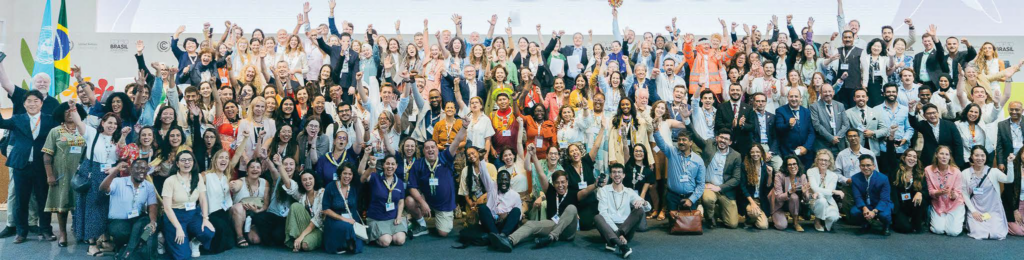
COP30 in Belém, Brazil, was a stark reminder of the real-time impacts of climate change. Scorching heat, torrential downpours and flooding tested the resilience of delegates, volunteers and the people of Belém day after day. Despite these challenges, the city welcomed us warmly and participation was unprecedented – 56 000 delegates and 193 country representatives plus the EU gathered, making this one of the largest COPs in history.
This was a COP where protest was permitted and voices were heard. The arrival of a flotilla of indigenous communities from across the Amazon was a living metaphor for inclusion, justice and the power of those too often left out of the conversation.
As Johan Rockström, Director of the Potsdam Institute for Climate Impact Research reminded us: “The global curve of greenhouse gas emissions needs to bend next year, 2026, not sometime in the future. We need to start, now, to reduce CO2 emissions from fossil fuels, by at least 5% per year. This must happen in order to have a chance to avoid unmanageable and extremely costly climate impacts affecting all people in the world.”
Brazil’s President Luiz Inácio Lula da Silva championed the development of road maps to transition away from fossil fuels and tackle deforestation at the world leaders’ meetings. The World Green Building Council (WorldGBC) team arrived at COP30 with hope. And while the final outcomes showed only incremental progress, we remain optimistic about new developments like the Global Action Agenda. This framework offers a clearer blueprint for implementation – one that WorldGBC is contributing to, and that the private sector and civil society are ready to step up to and deliver on.
The energy transition
Despite the tensions in climate diplomacy, one thing is clear – the energy transition is happening. As Simon Stiell, UNFCCC Executive Secretary, put it: “The economics of the energy transition [the transition to renewable energy] are inevitable and already underway.” With solar and wind now the lowest-cost sources of power in 90% of the world, accelerating investment in clean energy and infrastructure is in every country’s self-interest – otherwise they risk loss in competitiveness, rising energy costs and losing out on energy security.
Buildings are on the front line of this transition. They shape how we use energy and can support renewable energy production and provide demand signals for industrial decarbonisation. They also define how we adapt to climate impacts and how we deliver resilience for communities worldwide. This was recognised in the Global Climate Action Agenda – a five-year framework designed by the High-Level Climate Champions, and endorsed by the UNFCCC and the COP30 Presidency, to accelerate climate implementation and connect solutions from Parties (nations) and non-Party stakeholders. I was gratified that buildings were at the forefront of both energy efficiency and resilience conversations at this COP. This matters because the built environment is no longer a side note – it is now firmly recognised as central to the new clean and green economy, thanks to the tireless advocacy efforts of the Green Building Council community and leaders from the global sustainable and decarbonised building movement.
How WorldGBC showed up
At COP30, WorldGBC showed up with climate and sustainability solutions. As an official observer to the UNFCCC process, our mission was clear: ensure the built environment and the businesses at the heart of transforming the sector are heard and recognised as essential to climate progress.
WorldGBC’s COP delegates spoke at 18 different events, representing our network of 85+ Green Building Councils and 53 000 members, proving that sustainable, climate-resilient buildings are not only possible – they are profitable, scalable and essential for thriving economies.
A particular highlight for me was the session on “Financing Resilient Built Environments: Solutions for Infrastructure, Housing and Informal Settlements”. At this UNFCCC official side event, I made the case for scaling finance to build resilient housing and achieve justice and equity for vulnerable communities and informal settlements. It was an emotional moment for me. I reflected how, in my home country, Colombia, decades of conflict plus climate change have displaced more than 8 million people, many rebuilding their lives in self-built housing. So, for me the lesson is clear, from Bogotá to the Amazon: resilience depends as much on social and financial inclusion as on physical infrastructure.
Another highlight was WorldGBC’s announcement of the expansion of our Building the Transition programme to accelerate national decarbonisation and resilience road maps across Africa and Asia-Pacific – two regions critical for global climate progress. These road maps, developed in collaboration with UNEP’s Global Alliance for Buildings and Construction (GlobalABC), empower national coalitions of Green Building Councils and stakeholders to convert ambition into projects and region-specific action.
Our initiative, supported by GlobalABC, Habitat for Humanity and WRI, was chosen by the COP Presidency as one of the official Plans to Accelerate Solutions (PAS) – a key pillar of the COP30 Action Agenda. Through this recognition, climate road maps have been elevated as an official PAS, reaffirming the position of buildings at the core of global climate solutions and implementation efforts.
We also succeeded in putting forward the PAS known as “Building Efficiency, Electrification and Renewable Integration” (BEERI) in partnership with C40 Cities and the International Energy Agency (IEA) – which provides the tangible steps needed to align policy, mobilise finance and embed transparent monitoring and verification to drive measurable emissions and resilience gains. To support GlobalABC and its partners, we will help advance the PAS on the Buildings Breakthrough and build on the work we led under Priority Action 1, enabling governments to deliver near-zero emission and resilient buildings (NZERB). You can explore more in our interim report*.
Other key outcomes
While many parties were left disappointed that both fossil fuel and deforestation road maps were excluded from the final text, the COP30 Mutirão delivered several important new initiatives on adaptation, implementation and social justice.
- Goal on adaptation: The final Mutirão text called for a tripling of adaptation finance – a welcome step, however clarity on baselines will be critical for impact, and the 2035 target date is five years later than the original proposal.
- Fossil fuel road maps: Colombia and the Netherlands will co-host the first International Conference on the “Just Transition Away from Fossil Fuels” in April 2026 in Santa Marta, Colombia. The absence of fossil fuel road maps in the final COP30 text was a major disappointment but hardly a surprise, given the geopolitical context. There are encouraging signs: over 80 countries called for a fast, fair and fully financed transition away from fossil fuels and aim to develop the road map idea, or a blueprint for an orderly, equitable and economically coherent transition with the support of the Brazilian Presidency. This includes advancing the fossil fuel and deforestation road maps at COP31, guided by the outcomes of the Santa Marta conference.
- Implementation push: On COP30’s opening day, the UN synthesis report confirmed global emissions are finally bending downwards – but not fast enough. New analysis from the United Nations shows emissions could fall 12% by 2035 compared to 2019, based on updated national climate plans or Nationally Determined Contributions (NDCs) from 113 Parties.
To close the gap and keep 1.5°C within reach, COP30 launched the Global Implementation Accelerator (GIA) and the “Belém Mission to 1.5°C”. These initiatives aim to turn pledges into delivery by strengthening national climate and adaptation plans.
- Action Agenda: COP30 streamlined overlapping initiatives into 117 time-bound, target-driven plans under a new framework of six pillars and 30 objectives, providing a platform to bridge outcomes in the negotiations with real-world action.
- Financing and nature: Rich nations pledged to triple adaptation finance to US$120 billion annually by 2035. The Tropical Forest Forever Facility launched with US$125 billion in pledges to protect tropical forests.
- Social equity: Indigenous and Afro-descendant rights were recognised for the first time in a COP agreement, a landmark for climate justice that will help ensure greater participation for communities who often face the most severe climate impacts.
COP31 and beyond
COP30 reminded us that ambition still lags behind science, but multilateralism endured and important new foundations were laid for accelerated action. Looking ahead, Brazil, Türkiye and Australia will play pivotal roles in shaping COP31. Their leadership will be critical in advancing fossil fuel phase-out, scaling finance for adaptation, reforming financial architecture and ensuring ongoing visibility and relevance to the Action Agenda, as well as governance and accountability. One thing is clear: we can no longer rely solely on governments. Private sector leadership will be the engine of progress. worldgbc.org


