AI in ESG Reporting: balancing efficiency with credibility
Artificial intelligence is reshaping ESG reporting – enabling efficiency, scale and deeper insights – while raising governance, environmental and ethical challenges that demand transparency, accountability and robust data stewardship.
When Alan Turing – British mathematician, logician and computer scientist, and widely regarded as the father of modern computing – asked, “Can machines think?” in 1950, the question was largely philosophical. Today, it has become a defining business reality. Artificial Intelligence (AI) is no longer an emerging concept or experimental tool: it is rapidly reshaping how organisations write, analyse, predict, create and make decisions. For ESG (environmental, social and governance) professionals, this shift presents a compelling opportunity. AI can accelerate data collection, simplify complex reporting processes, identify patterns across large datasets and support more informed sustainability strategies. In an environment where ESG disclosures are becoming more data-driven, regulated and scrutinised, these capabilities are difficult to ignore.
Yet the rapid adoption of AI also introduces a paradox. If ESG reporting is built on transparency, credibility and accountability, organisations must ask whether AI strengthens these principles or creates new risks of its own. As businesses increasingly rely on AI to support ESG reporting, they must also confront its environmental footprint, ethical implications and governance challenges.
AI in ESG Reporting
ESG reporting requires organisations to collect, analyse and interpret large volumes of data across multiple business units, regions and reporting frameworks. As regulatory requirements and stakeholder expectations continue to grow, ensuring ESG disclosures are accurate, consistent and defensible becomes increasingly challenging.
AI is emerging as a valuable tool in this space. By automating data processing, identifying trends and anomalies, and generating insights at scale, AI can reduce administrative burdens while improving reporting efficiency, accuracy and decision-making.

Here are some of the ways AI has helped improve the quality of ESG reporting:
AI can support ESG reporting by reducing the administrative burden of collecting, consolidating and validating data from multiple departments, facilities and external stakeholders. By automating data extraction and standardising information from spreadsheets, invoices and disconnected systems, AI can help organisations calculate ESG metrics more efficiently, identify data gaps and align outputs with relevant reporting frameworks.
AI can also improve reporting accuracy by flagging anomalies, inconsistencies and potential errors, particularly in complex areas such as Scope 3 emissions where data, often fragmented, comes from multiple suppliers and methodologies. Beyond reporting, AI can strengthen ESG strategy through predictive analytics, helping organisations assess climate-related risks, model emissions reduction pathways and anticipate impacts on operations and supply chains. It can also enhance materiality assessments by analysing internal and external data, identifying emerging trends, supporting peer benchmarking and highlighting priority areas for action.
Risks of adoption
While AI offers significant opportunities to improve ESG reporting, organisations must also recognise the risks associated with its adoption. ESG reporting is ultimately built on trust, transparency and accountability. Without appropriate governance, AI can undermine these principles and expose organisations to regulatory, operational and even reputational risks.
Black box methodologies
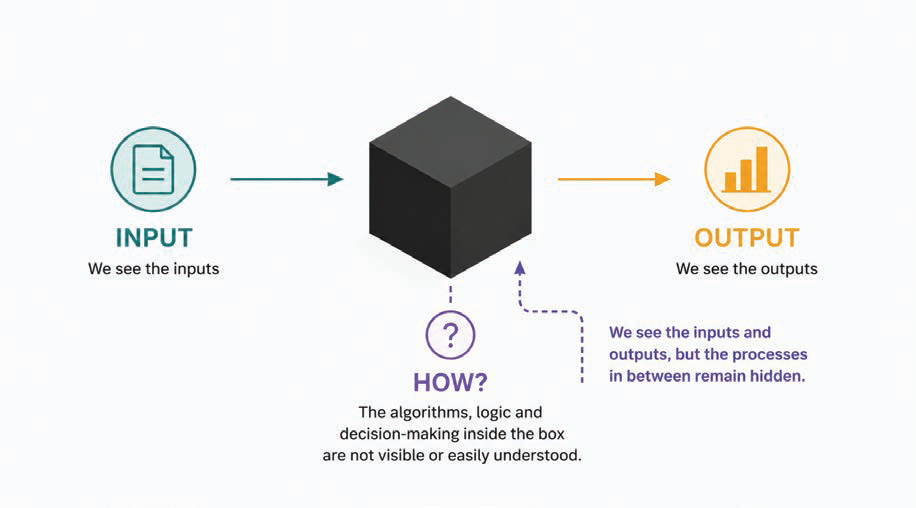
Many AI systems operate as “black boxes”, producing outputs without clearly explaining how conclusions were reached. In the context of ESG reporting, unclear methodologies and hidden assumptions can generate sustainability scores, risk assessments and recommendations that are difficult to verify, justify or audit. This lack of transparency can create challenges for both assurance providers and stakeholders seeking confidence in reported outcomes.
Bias in social metrics
AI models learn from historical datasets, which may contain inherent biases. If these biases are not identified and addressed, AI can inadvertently reinforce skewed assessments of social issues such as labour practices, diversity, equity and inclusion, or human rights impacts. As a result, organisations may make decisions based on incomplete or distorted information.
Greenwashing risks
AI can accelerate research and sustainability reporting, but it can also amplify misleading claims. Without robust review and approval processes, organisations may unintentionally present AI-generated sustainability statements as verified facts. This increases the risk of greenwashing, potentially damaging stakeholder trust and exposing organisations to regulatory scrutiny.
Garbage in, garbage out
Perhaps the greatest risk of all is that AI outputs are only as reliable as the data on which they are based. Fragmented datasets, poor-quality source information and insufficient human validation can lead to inaccurate analyses and misleading disclosures. Rather than correcting underlying data quality issues, AI may simply accelerate the production of flawed results. For this reason, strong data governance remains essential, regardless of how sophisticated the AI system may be.
AI’s ESG footprint
Training and operating large AI models requires substantial computing power, placing increasing demand on data centres and electricity grids as AI adoption continues to grow.
The environmental footprint extends beyond energy consumption. AI data centres require large volumes of water for cooling, while the production of specialised hardware contributes to resource extraction, emissions and electronic waste across global supply chains.
These impacts are amplified when AI infrastructure is powered by fossil fuels. Some projections estimate that the AI industry’s emissions could reach between 24 and 44 million metric tonnes of CO₂ annually by 2030. As a result, organisations should view AI not only as a tool for improving sustainability performance, but also as a sustainability issue that requires careful management and oversight.
Best practices
To realise the benefits of AI while avoiding the risks of misinformation, bias and greenwashing, organisations must adopt a robust responsible AI governance framework. Responsible AI is not simply about complying with regulations: it is about ensuring that AI-generated insights are accurate, transparent, ethical and auditable throughout the reporting process.
According to Papagiannidis, Mikalef and Conboy (2025)*, effective AI governance should be built on three pillars: structural, procedural and relational practices. Structural practices involve assigning clear accountability for AI systems, including defined ownership, oversight and decision-making responsibilities. ESG professionals should ensure that AI outputs remain subject to human review and that accountability for disclosures cannot be delegated to algorithms alone.
Procedural practices focus on how AI is deployed and monitored. Organisations should implement rigorous data validation processes, maintain audit trails for AI-generated outputs and regularly test models for accuracy, bias and consistency. Transparency is particularly important in ESG reporting, where stakeholders increasingly expect disclosures to be explainable and supported by verifiable evidence. AI-generated content should therefore be traceable back to credible data sources and subject to independent verification where necessary.
Relational practices emphasise stakeholder engagement, cross-functional collaboration and AI literacy. Sustainability teams, data specialists, compliance professionals and senior leadership should work together to ensure that AI is applied responsibly. Equally important is developing employee understanding of AI’s limitations, reducing the risk of overreliance on automated outputs.
Ultimately, AI should be viewed as a powerful decision-support tool rather than a replacement for professional judgement. Organisations that combine AI innovation with strong governance, transparency and human oversight will be best positioned to improve ESG reporting while maintaining stakeholder trust and credibility.
IT’s Powerful, but not magic
AI’s outputs are only as reliable as the data, methodologies and oversight that underpin them. While AI can enhance decision-making and streamline reporting, it cannot replace professional judgement, stakeholder engagement or effective governance. Ultimately, organisations that combine AI innovation with strong controls and human oversight will be best positioned to deliver credible, transparent and trusted ESG disclosures.